
Emails spell out alleged scandal in state crime lab testing, falsely reporting marijuana
OTTAWA COUNTY, Mich. – First uncovered by FOX 17, more on an alleged scandal in how state crime labs are testing and reporting marijuana, namely marijuana by-products with no visible plant matter, as felonies.
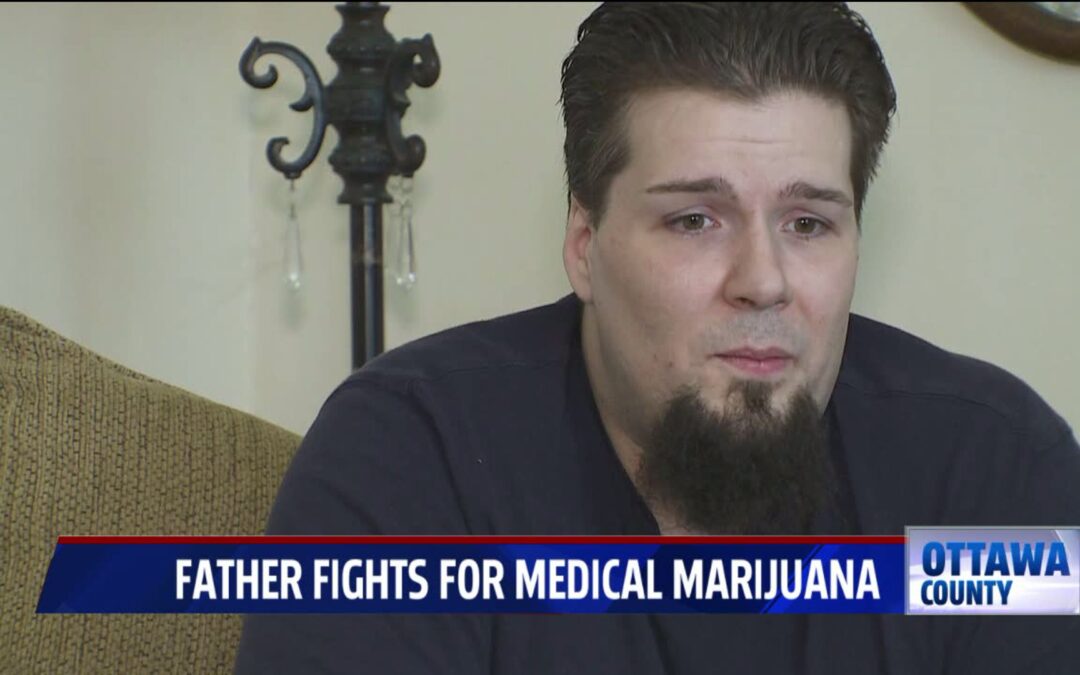
We first brought you the case of an Ottawa County father, Max Lorincz, who was slapped with a felony after he refused to plead guilty to a misdemeanor marijuana possession charge, as he is a medical marijuana card-carrying patient. Now he faces the felony charge of synthetic Tetrahydrocannibinol (THC) possession.

Lorincz lost custody of his 6-year-old son in part due to this felony.
After reporting on the case over nine months, FOX 17 exclusively reported a shocking email chain that spans months between Michigan State Police Forensic Science Division employees and the Attorney General’s office.
Obtained through the Freedom of Information Act, these emails show debates on how the state’s crime labs changed how they report marijuana. The defense, attorney Michael Komorn and Komorn Law, PLLC, is charging state agencies with directing the lab employees to falsely present results on marijuana products, including cases where plant material is not seen.
The result: felony charges Komorn argues are lies.
Komorn showed evidence in emails that MSP Forensic Science Division is being directed by the Attorney General’s office and the Prosecuting Attorneys Association of Michigan (PAAM) to change the way marijuana is reported to create felonies. PAAM is a non-profit, which is governed by a board of directors including the Attorney General.
"What is unique about this case is that they [the prosecution] are relying on the lab to report these substances so that they can escalate these crimes from misdemeanors to felonies,” said Komorn.
Documents obtained via FOIA, showcase emails about meetings (for instance, July 2013) and direct communication between MSP Forensic Science Division directors, scientists, PAAM, as well as officials with the AG’s office.
An excerpt from an email dated Dec. 13, 2013 suggests an AG official influenced the state crime labs on whether it is the lab’s responsibility to determine if THC tested is natural or synthetic; again, this is the difference between a misdemeanor and a felony.
A technical leader of controlled substances with MSP crime labs wrote an email to colleagues and quoted Ken Stecker, an official with the AG’s office:
“That is my opinion, THC is a schedule 1 drug regardless of where it comes from. I hope that helps. Ken”
Then, the technical leader of controlled substances at a state lab continues to direct other state lab personnel and write:
“Examiner’s that are identifying food products or other non-plant materials as marihuana without the visualization of any plant material should discontinue this practice. The final identification of all phases of testing can only be marihuana when plant fragments, portions, samples, plant hairs or actual plants are visualized by the scientist. To my knowledge, the only other two laboratories that have expressed this concern are Northville and Lansing.”
Komorn believes this policy change is not science-based.
“This is like a political decision, and somewhere in there they say well Ken Stecker is going to be the consultant on this going forward, and his position is that THC is a schedule 1,” said Komorn.
“That’s not the law. That’s an incorrect, illegal misinterpretation of the law that he then decrees as the policy for the state lab.”
This AG official’s “opinion” was written into lab procedure. Several emails show other MSP lab supervisors and scientists vehemently oppose it.
For example, a MSP Lansing controlled substances supervisor wrote his disagreements with this policy to colleagues, including an excerpt from an email dated Feb. 14, 2014:
“Prosecutor’s rely on our reports to determine what to charge a person with. A report that states delta-1-THC without any other statement would lead a Prosecutor to the synthetic portion of the law since this is the only place where THC is specifically listed. This could lead to the wrong charge of possession of synthetic THC and the ultimate wrongful conviction of an individual. For the laboratory to contribute to this possible miscarriage of justice would be a huge black eye for the Division and the Department.”
This supervisor wrote further concerns in an email to many colleagues nearly one year later, dated Jan. 28, 2015, writing in part:
“Upon reading this correspondence I immediately thought about the Guiding Principles training we receive yearly. Under Professionalism it states that “Conclusions are based on the evidence and reference material relevant to the evidence, not on extraneous information, political pressure, or other outside influences.” Whether or not an individual has a medical marijuana card is immaterial to how we report out our results.
When we made the previous changes I made it very apparent that I did not agree with it. One of my concerns was that by reporting out THC instead of marihuana it would lead to Prosecutors charging people with synthetic THC. This appears to be what the agency wants.”
Another MSP Northville lab scientist wrote the following to colleagues, stating concerns with new reporting policy:
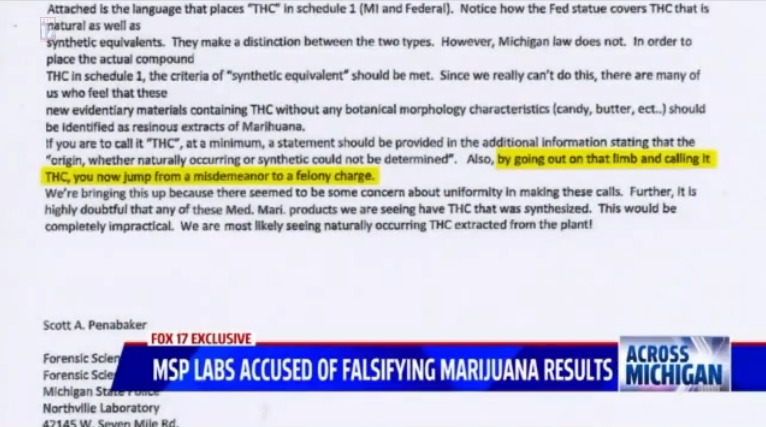
“In order to place the actual compound THC in schedule 1, the criteria of ‘synthetic equivalent’ should be met. Since we really can’t do this, there are many of us who feel that these new evidentiary materials containing THC without any botanical morphology characteristics (candy, butter, etc..) should be identified as resinous extracts of Marihuana.
If you are to call it ‘THC,’ at a minimum, a statement should be provided in the additional information stating that the ‘origin, whether naturally occurring or synthetic could not be determined.’ Also, by going out on that limb and calling it THC, you now jump from a misdemeanor to a felony charge.
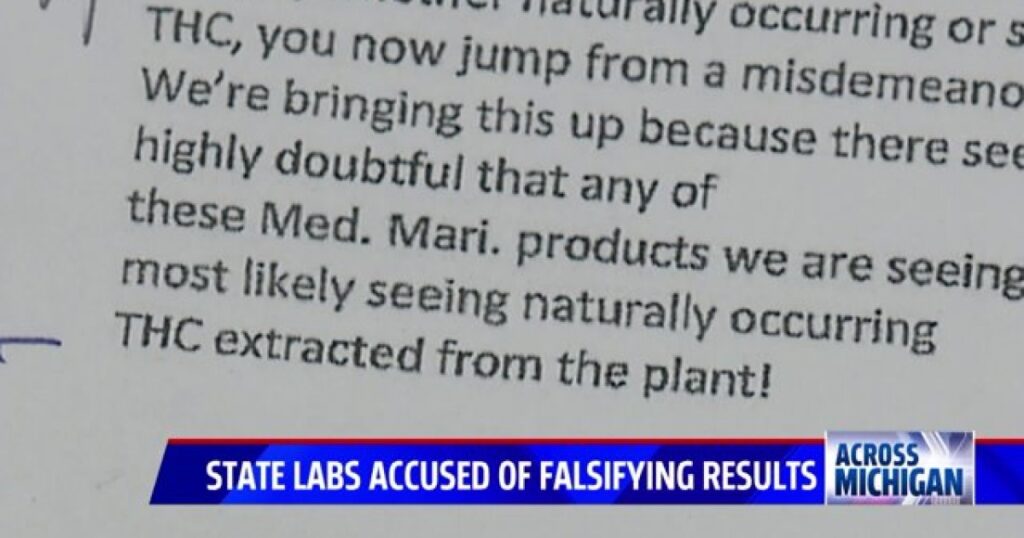
We’re bringing this up because there seemed to be some concern about uniformity in making these calls. Further, it is highly doubtful that any of these Med. Mar. products we are seeing have THC that was synthesized. This would be completely impractical. We are more likely seeing naturally occurring THC extracted from the plant!”
“The most damning evidence is that their own forensic scientists, when they're objecting to the way the lab is going to change their reporting policies, calls them out that they can't do it based on forensic science, and yet they do it anyways,” said Komorn.
Thursday afternoon, the Prosecuting Attorneys Association of Michigan’s President Michael Wendling responded to FOX 17’s questions with the following statements:
“The Michigan State Police Forensic Science Division sets its own testing and reporting protocols. Neither PAAM nor county prosecutors make those protocols.”
“The MSP Forensic Science Division makes its own decisions relative to the lab protocol. Any decision to report that the source of THC is undetermined does not create a misdemeanor or felony offense. Lab reports document the findings of scientific testing. Those findings, in conjunction with other relevant evidence are considered by prosecutors may be used in when the decision whether to charge a crime and which crime to charge is made.”
“Prosecutors do not receive requests to charge criminal cases from the MSP Forensic Science Division. The MSP Forensic Division reports scientific findings. Prosecutors receive those reports and use them to make decisions regarding whether there is sufficient evidence to pursue criminal charges. Any accusation that the Lab and PAAM are directing lab personnel to report crimes without evidence is untrue. PAAM has no authority over, nor does it direct the MSP Forensic Science Division.”
Yet again in this case, several lab scientists and supervisors expressed they are against this new marijuana reporting protocol.
As FOX 17 reported, the defense filed several motions in Ottawa County Circuit Court this week. The motions ask for Max Lorincz’s charges to be dismissed, as well as asking the accused organizations’ employees to show cause, or credible evidence to show science backs their protocol, in order to not be held in contempt of court.
The evidentiary hearing is set for Nov. 5.
FOX 17 also reached out to the Attorney General's office for comment, but has yet to hear back. Michigan State Police public affairs personnel released comment to FOX17 Wednesday.
Stay with FOX 17 for the latest developments and analysis of documents.https://www.fox17online.com/2015/10/29/emails-spell-out-alleged-scandal-in-state-crime-lab-testing-falsely-reporting-marijuana/
By: danachicklas
Posted at 7:53 PM, Oct 29, 2015