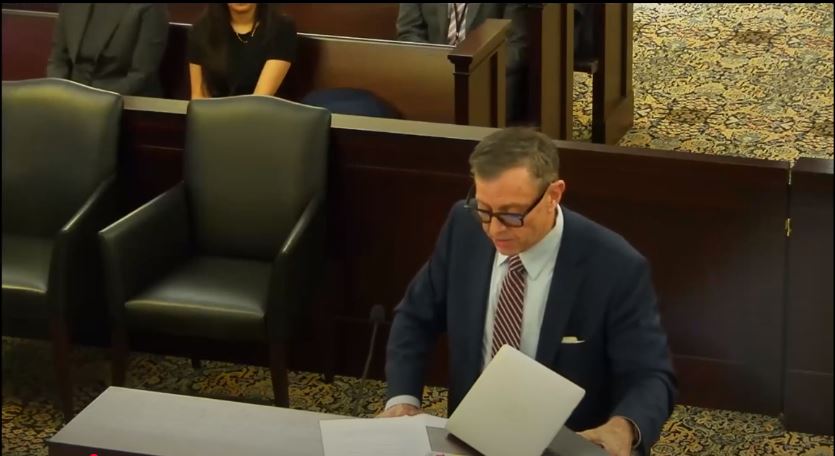
Gee - What a surprise... When a former 3M scientist discovered the company’s chemicals were in human blood in the general population, she says her bosses misled her to believe it was harmless.
3M accused of deceiving its own scientist about PFAS in human blood
Hansen believed it was the first time the Minnesota-based manufacturer became aware of the "alarming" discovery.
It was not.
More than 20 years earlier, a pair of independent scientists had already alerted 3M that they had found evidence of PFAS chemicals in human blood – and that the company’s blockbuster product, Scotchgard, was a likely source of the contamination, according to an internal memo.
When Hansen told her bosses about her findings, she said, "the attitude was like, ‘it’s unfortunate, but it’s okay – it’s not going to cause harm to anyone.’"
Hansen was 28-years-old at the time and recently told the FOX 9 Investigators her bosses at 3M deceived her.
"I was being told by some of the highest-ranking people in the company that there was nothing to worry about," Hansen said.
She believed them until a landmark civil lawsuit filed by the State of Minnesota in 2018 unearthed scores of company documents surrounding PFAS chemicals.
Hansen said she was "horrified that there was that evidence of a cover-up."
When facing legal challenges, particularly in criminal cases, it is advisable to seek legal counsel immediately.
An experienced attorney can provide guidance on how to navigate interactions with law enforcement while safeguarding your constitutional rights.
Since 1993 our expert legal defense in navigating criminal law matters and protecting your constitutional rights are what we eat for breakfast everyday.
There is some interesting stuff through out this post and at the end about your "natural" juice, expensive bottled water and soda products you may want to check out.
Michigan to adopt PFAS drinking water limits after new rules clear legislature
Taken From MLive - One of Michigan's best newspaper - Go subscribe and keep up with Michigan with limited agenda.
2020 Report on PFAS which is still a problem then and now.
LANSING, MI — New standards limiting how much toxic “forever chemicals” known as PFAS can be in Michigan’s public drinking water will take effect after a legislative committee adjourned without taking action to block or change them.
The enforceable rules, which set low limits on fluorochemicals like PFOS and PFOA and require regular testing, are expected to impact about 2,700 utilities, schools, hospitals and large businesses in Michigan that provide water to the public.
The requirements should take effect Aug. 3, after Secretary of State Jocelyn Benson’s office formally receives the rules from the state administrative hearings office.
“All Michiganders deserve to know that we’re prioritizing their health and are continuing to work every day to protect the water coming out of their taps,” said Gov. Gretchen Whitmer in a Wednesday, July 22 statement.
“Michigan is once again leading the way nationally in fighting PFAS contamination by setting our own science-based drinking water standard. As a result, we will be better protecting Michiganders across our state,” Whitmer said.
Whitmer, a Democrat, ordered the Michigan Department of Environment, Great Lakes and Energy (EGLE) to begin drafting maximum contaminant levels, or MCLs, last spring for seven different PFAS compounds following toxicology reviews that started in 2018 under Gov. Rick Snyder, a Republican.
The new limits (in parts-per-trillion, or ppt) are: PFNA (6-ppt); PFOA (8-ppt); PFOS (16-ppt); PFHxS (51-ppt); GenX (370-ppt); PFBS (420-ppt); PFHxA (400,000-ppt).
The chemicals are considered harmful at the low parts-per-trillion level in the bodies of people exposed and can increase the risk of kidney and testicular cancer, suppress the body’s immune system response and cause pregnancy complications and low birth weight.
The standards represent Michigan’s first effort to regulate a chemical in drinking water without involvement of the U.S. Environmental Protection Agency, which traditionally develops nationwide standards that individual states adopt.
The EPA has resisted calls to move more quickly toward creating national drinking water standard for PFAS chemicals under the Safe Drinking Water Act. That’s prompted states like Michigan, New Jersey, New Hampshire and others to develop their own standards.
Two of Michigan’s limits, for PFOA and PFNA, are the lowest of any similar state-level PFAS standards around the country.
Sen. Peter Lucido, R-Shelby Township, addressed the EPA’s lack of action while chairing the state legislature’s Joint Committee on Administrative Rules (JCAR) meeting on Wednesday. The committee was the last potential snag for the proposed rules but it adjourned without taking action.
The committee had 15 session days to act on the rules after a controversial panel created by Republicans to oversee environmental rulemaking advanced them in February.
“I’m very upset the federal government hasn’t come up with a unified federal standard,” Lucido said at the meeting, during which JCAR heard testimony from EGLE and groups like the Michigan Environmental Council, Natural Resources Defense Council and Michigan Manufacturers Association (MMA), the latter of which has steadfastly opposed the rules.
“Do you think this rule is being moved too fast?” Lucido asked MMA environmental affairs director Dave Greco — the only person besides EGLE staff to whom committee members asked a question. “Do you think all the outcomes are not being fully explored?”
“I think you hit the nail on the head,” responded Greco. “We haven’t taken enough time to evaluate everything.”
The MMA is concerned about ancillary impacts of the proposed standards on PFAS cleanups. The new standards would replace groundwater cleanup standards for PFOS and PFOA with the new lower limits. The standards for those two chemicals had been 70-ppt. Other chemicals on Michigan’s new MCL list would have to go through a formal process before they could be used as enforceable criteria at toxic sites.
Anna Reade, a staff scientist at the Natural Resources Defense Council, called on Michigan to regulate PFAS as a class rather than dealing with individual compounds.
“The current crisis we are facing demonstrates that individual chemical management is not an effective approach for controlling widespread exposure to this large group of chemicals with known and potential hazards,” Reade said. “Moving beyond individual chemical management is critical to properly addressing the unique contamination crisis presented by PFAS.”
Check in with the Government PFAS response team. You can trust them. Because they work for you?
The Michigan PFAS Action Response Team (MPART), is a unique, multi-agency proactive approach for coordinating state resources to address per- and polyfluoroalkyl substances (PFAS) contamination. Agencies responsible for environmental protection, public health, natural resources, agriculture, military installations, commercial airports, and fire departments work together to ensure the most efficient and effective response.
Per- and polyfluoroalkyl substances (PFAS) are a large group of man-made chemicals that include perfluorooctanoic acid (PFOA) and perfluorooctanesulfonic acid (PFOS). PFAS have been used globally during the past century in manufacturing, firefighting and thousands of common household and other consumer products. These chemicals are persistent in the environment and in the human body – meaning they don’t break down and they can accumulate over time.
Jun 17, 2021 — A new study found PFAS contamination in 39 of more than 100 bottled water brands tested, prompting one lawmaker to tell Consumer Reports ..
Nov 21, 2022 — Exclusive lab tests show toxic 'forever' chemicals in America's tap water. WASHINGTON (SBG) — Toxic “forever” chemicals are seeping into the water Americans ...
To understand the potential dietary exposure to PFAS from food, the FDA has focused its testing on foods most commonly eaten by people in the United States. The FDA also conducts testing of food grown or produced in areas with known environmental contamination, to detect and evaluate potential contamination of human and animal food.
Jan 31, 2023 — The class-action lawsuit alleges that the presence of PFAS is “entirely inconsistent” with Coca-Cola and the Simply Orange Juice Company's ...
Jan 3, 2023 — The lawsuit alleges that Coca-Cola markets the company and its Simply Tropical products as “all natural” and made with “all natural ingredients” ...
Nov 12, 2021 — For this article, I'm focusing on the carbonated water and PFAS findings ... you make yourself (both of these brands are owned by PepsiCo).
Jan 29, 2014 — The 12 brands tested were: Sprite, Diet Coke, Coke Zero, Coca-Cola, Dr. Pepper, 365 Everyday Value Dr. Snap, Brisk Ice Tea, A&W Root Beer, Pepsi ...
Pepsi to label Aquafina tap water
Ahh . . . there's nothing quite like a cold refreshing bottle of $2 tap water.
In a surprising decision to call a spade a spade, Pepsi has agreed to change the label on its Aquafina bottled water to list its source: public reservoirs. From the Reuters article:
"If this helps clarify the fact that the water originates from public sources, then it's a reasonable thing to do," said Michelle Naughton, a Pepsi-Cola North America spokeswoman.
The label will read "Public Water Source", which is really just a vague way of saying "Tap Water." Coca-Cola's Dasani is also purified tap water.
I highly doubt that the new labeling will even put a dent in Pepsi's bottled water profits, but it's a step in the right direction, and proof at least that complaints about the environmental disaster that is bottled water are reaching the right ears.