
Firsthand Accounts Allege Michigan Forfeiture System Is `Broken’
Annette SHATTUCK’s mother was clipping coupons at their Port Huron home when local law enforcement came rushing in wearing masks and camouflage on July 28, 2014.
The officers from the St. Clair County Drug Task Force were there to execute a no-knock search warrant. And Shattuck alleges that through civil asset forfeiture, the officers seized a wide variety of items from her house, including car seats, hammers, saws and $85 that was inside birthday cards for one of her children.
Although Shattuck says she and her husband weren’t even charged with a crime for five and a half months and they still haven’t been convicted, those items are still being held by the police.
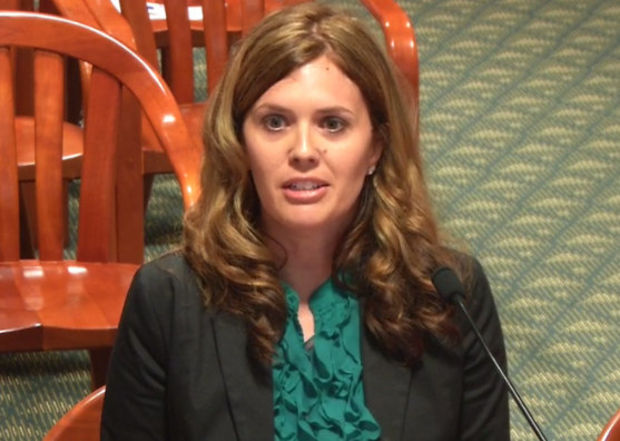
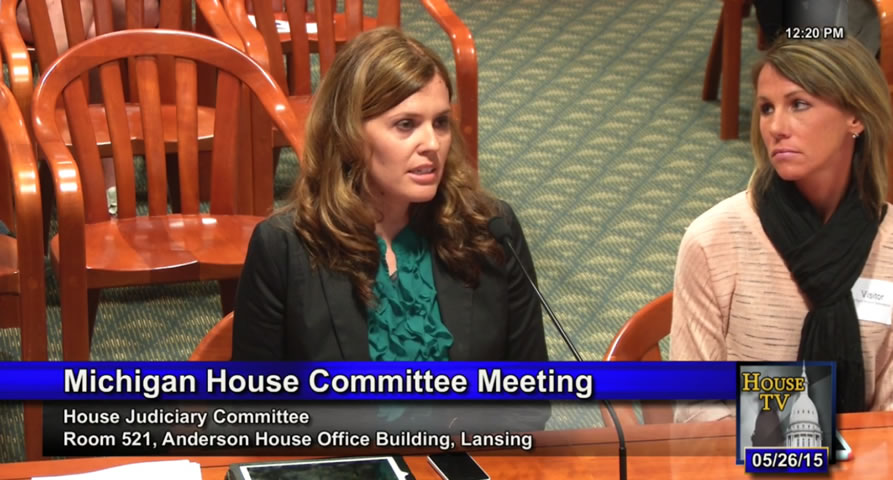
“They leave you with nothing,” Shattuck said of her situation, in an interview today. Shattuck was one of a group of individuals who spoke out today in favor of reforms to the civil asset forfeiture process as the House Judiciary Committee voted to advance new reporting requirements and increased legal standards for forfeiture.
Lawmakers are also trying to determine whether stories like Shattuck’s are isolated anecdotes with debatable details or widespread problems that point to systemic issues.
Asset forfeiture allows law enforcement to punish suspected criminals by taking money and property that officers believe were obtained through or involved in illegal activity.
According to a 2014 report from the Michigan State Police (MSP), law enforcement agencies in the state seized some $24 million in assets in 2013 related to drug crimes.
The reporting requirements in HB 4500, HB 4503 and HB 4504 are meant to help the public better track the forfeitures. Other bills in the package, which includes HB 4499, HB 4506, HB 4507 and HB 4508, would increase the legal standard for forfeiture from a preponderance of the evidence to “clear and convincing” evidence.
Those who are most in favor of civil asset forfeiture reform say the bills are merely a step in the right direction to bigger reforms. Meanwhile, the law enforcement community has been somewhat quiet about the legislation.
Judiciary Chair Klint KESTO (R-Commerce Twp.) said today that reporting bills would ultimately help determine what needs to be done.
“Everybody has their opinion we should go in this direction or that direction,” Kesto said. “That’s premature. Let’s get the data.”
Shattuck and her attorney, Michael KOMORN, who testified today, said the reporting requirements are good first steps. But greater reform is needed. Komorn said he’s heard stories about individuals having all kinds of items seized under forfeiture, including a 1925 mandolin, Bridge cards and $37 out of a woman’s purse.
Many of the cases, like Shattuck’s, involve the state’s medical marijuana laws, which don’t fit with asset forfeiture, Komorn said.
The laws can be complicated and if a patient or grower isn’t following them exactly right, the person could be subject to forfeiture.
In an interview, he detailed a case of someone whose house was raided. Law enforcement kept the seized items for a year up until the start of the trial when they all of sudden gave the items back.
“You know why they do that? Because they can,” Komorn said. “There are no checks and balances.”
When Shattuck’s house was raided in July 2014, her children were home alone with Shattuck’s mother. Shattuck said the officers separated her mother from the children as the raid took place. Her children still talk about it, Shattuck said.
When they see a police car, the 9-year-old daughter asks, “Is it coming to my house?” Shattuck was eventually charged for crimes related to the manufacturing of marijuana. The case is ongoing.
Ginnifer HENCY, of Kimball, also shared her forfeiture story today. She said law enforcement raided her house, although she believes she was compliant with the state’s medical marijuana laws.
Police took iPads and phones, she said. “They have had my stuff for 10 months,” she said.
Thomas BUCKLEY, undersheriff of the St. Clair County Sheriff’s Office, said he read through the police reports of both Hency and Shattuck’s cases. “I don’t see anything in the report that anyone did anything improper,” he said.
The task force, which is funded through a millage, usually only seizes items that are involved in the crime itself or that can be directly tied to the crime, Buckley said.
And he said sometimes offenders store proceeds from drugs in unusual places. Because cases are ongoing, Buckley couldn’t provide many details about the situations. But he said the raids were part of a large investigation involving federal agents and multiple locations involved in drug dealing. “A lot of it was under the guise of legitimate medical marijuana,” Buckley said.
As for forfeiture overall, Buckey said he can’t speak for every law enforcement agency, but he believes it’s a positive. “It takes the profit out of the drug trade for a lot of people,” Buckley said.
In an interview earlier this year, Robert STEVENSON, a former law enforcement officer who now leads the Michigan Association of Chiefs of Police, urged lawmakers to look beyond individual anecdotes when it comes to asset forfeiture.
Overall, Stevenson argued the system is working (See “As Lawmakers Push Reforms, Law Enforcers Defend Forfeiture Programs,” 5/1/15).
Komorn had a different take. He said he has an office full of documents on cases where asset forfeiture was used inappropriately. “The system is broken,” he said, holding a stack of documents on other cases. “These are examples.”
Asked if stories like Shattuck’s and Hency’s are anecdotes or widespread problems, Kesto said he couldn’t answer that and he didn’t know the specific details of their cases. “These stories are anecdotal in nature,” Kesto said. “However, I think it’s unfortunate the way these woman told their stories. If that’s what happened, that’s a real, real problem and that cannot be tolerated. “That’s why we need the reporting bills to see what’s going on.”