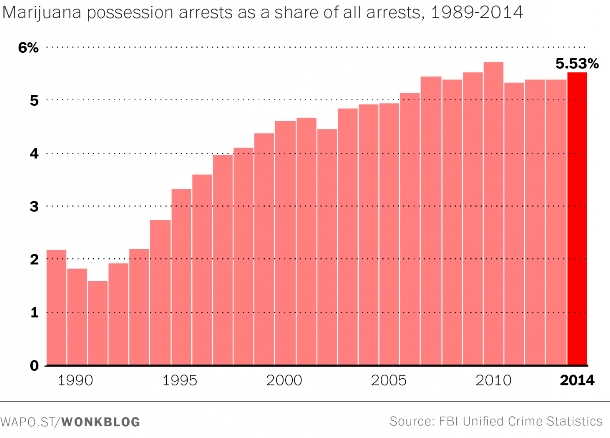
Marijuana Possession Arrests FBI Stats 1989-2014
WTF

WTF

Last month, as the Michigan Senate debated a host of reforms to the state’s civil asset forfeiture laws, the Michigan State Police released its Asset Forfeiture Report, the annual publication required by state law that details Michigan’s drug-related forfeiture activities.
The report aggregates data from 629 local police departments, sheriff’s departments, and multijurisdictional task forces, plus the Michigan State Police. Civil forfeiture is a policy that enables law enforcement authorities to seize property or currency if they suspect it is involved in, or is the result of, a crime.
Since forfeiture proceedings are civil, not criminal, property owners are afforded few due process protections. With no presumption of innocence or right to an attorney, innocent property owners fighting the seizure of their homes and life savings face a legal landscape skewed against them in nearly every way possible.
According to Michigan’s forfeiture report, in 2014, state law enforcement agencies seized and forfeited $23.9 million’s worth of cash and property. That sum includes more than $14 million’s worth of assets forfeited under state law, and an additional $8 million provided to Michigan law enforcement agencies via the federal equitable sharing program.
Taking into account the cost of running forfeiture operations, Michigan law enforcement netted a cool $20.4 million in revenue, every penny of which they can spend without political oversight and with little accountability—conditions that are ripe for abuse.
Here are some of the highlights:
• 8,558 cases—80 percent of all forfeiture cases in Michigan—were so-called “administrative forfeitures,” meaning that they never saw the inside of a courtroom. Instead, a law enforcement agency—often the agency that made the initial seizure and stands to gain financially from the forfeiture, acts as judge, prosecutor, and jury all in one.
• The number-one forfeiture target in Michigan is cash. Michigan law enforcement agencies seized $11.1 million in cold hard cash last year, which accounts for 79 percent of the value of all seized assets and property that were forfeited under state law. Cash presents a particularly inviting target for law enforcement agents. Most bills in circulation are tainted with narcotics, making drug-dog “alerts”—a frequent justification for cash seizures—exceedingly likely, even if the owner has nothing whatsoever to do with the drug trade.
• “Conveyances”—vehicles and vessels allegedly used to transport drugs or drug proceeds—were the second-largest category of forfeited item. Michigan forfeited 2,212 vehicles and four vessels last year, for a total value to law enforcement of $1.9 million. Detroit police in particular have faced sharp criticism for their propensity to seize vehicles on highly dubious grounds. In 2008, 44 vehicles were seized from the patrons of the Detroit Contemporary Art Institute’s “Funk Night,” because the museum had failed to obtain a liquor license. Each patron had to pay $900 to get his car back, and a judge later ruled the seizures unconstitutional.
• Twelve percent of forfeiture funds were used to cover the cost of personnel and overtime, placing individual members of the law enforcement community directly and personally reliant on forfeiture for their livelihoods, a significant conflict of interest.
A Margarita Machine?
Forty-four point six percent of forfeiture revenues were used for equipment purchases. While much, if not most, of this category may be above-board (bulletproof gear or body cameras, for example), law enforcement agencies around the country have faced criticism for using forfeiture funds to buy all manner of “equipment” ranging from the outlandish (helicopters and armored personnel carriers) to the absurd (margarita machines).
Law enforcement agencies should be generously funded and fully equipped, but the opacity of forfeiture-related purchases makes it impossible to separate the good from the bad.
The report raises as many questions as it purports to answer.
How many property seizures were accompanied by criminal charges and convictions? How much additional forfeiture revenues were generated in cases unrelated to drugs? What equipment is law enforcement buying with its untraced millions? Why are personnel directly financed by forfeiture funds, given the obvious conflict of interest? And why did 56 agencies not file any documentation whatsoever?
Fortunately, answers to these questions may be forthcoming. Last week, the Michigan state Senate unanimously passed a modest reform package that greatly enhances the reporting requirements for law enforcement.
If Gov. Rick Snyder, R-Mich., signs the seven-bill package, Michiganders will finally get to see exactly how often civil forfeiture is accompanied by criminal charges and convictions, and exactly how forfeiture funds are being spent.
The reform package also raises the evidentiary standard in forfeiture cases from a “preponderance of the evidence” to “clear and convincing,” a much more fitting standard, given that what is often at stake are people’s homes and life savings.
Jason Snead / @jasonwsnead / October 16, 2015 /

2013 MMMP STATISTICS FINAL REPORT
The Bureau of Health Statistics report regarding the Michigan Medical Marihuana Act Program
Other updates
ENROLLED HOUSE BILL No. 4851
Act No. 512 Public Acts of 2012
Approved by the Governor December 27, 2012
Filed with the Secretary of State December 28, 2012
EFFECTIVE DATE: April 1, 2013
ENROLLED HOUSE BILL No. 4834
Act No. 514 Public Acts of 2012
Approved by the Governor December 27, 2012
Filed with the Secretary of State December 28, 2012
EFFECTIVE DATE: April 1, 2013
PLEASE VISIT THESE SITES FOR THE MOST CURRENT INFORMATION
There are some declassified Oval Office tapes from 1971-1972 that reveal the foundation of marijuana criminalization is misinformation, culture war and prejudice.
The Shafer Commission was appointed by President Nixon and conducted one of the most comprehensive examination and assessment of marijuana performed by the US government. The Oval Office tapes highlight the discrepancy between Nixon’s personal agenda and the commission’s recommendations.
Here are a few excerpts from a CSDP.org research report.
“The most important recommendation of the Commission was the decriminalization of possession and non-profit transfer of marijuana. Decriminalization meant there should be no punishment – criminal or civil – under state or federal law. The day before the Commission released its report President Nixon told Bob Haldeman: “We need, and I use the word ‘all out war,’ or all fronts . . . have to attack on all fronts.” The conversation went on to plan a speech about why Nixon opposed marijuana legalization and doing “a drug thing every week” during the 1972 presidential election year.”
“One year after Nixon’s “all out war” marijuana arrests jumped over 100,000 to 420,700 people. Since the Commission recommended marijuana offenses not be a crime nearly 15 million people have been arrested.”
“The impact of the marijuana laws has grown. In fact in recent years the FBI has reported a record number of marijuana arrests – last year 734,497 were arrested for marijuana, 80 percent for possession. From 1972-2000, 13,265,105 were Americans arrested on marijuana charges, countless families have been destroyed by marijuana enforcement. To what end? The marijuana laws have not prevented nearly 80 million Americans from trying marijuana.”
There are many articles, websites and lots more in depth information that one can read and learn a lot. Below are couple links for more info.
http://www.csdp.org/news/news/nixon.htm
http://norml.org/component/zoo/category/celebrating-35-years-of-failed-pot-policies
http://www.drugpolicy.org/new-solutions-drug-policy/brief-history-drug-war
Anyhow…here’s some stats to think about
U.S. Marijuana Arrests 1972-2000
(Source FBI, Uniform Crime Reports, 1972-2000.)
1972 – 292,179
1973 – 420,700
1974 – 445,000
1975 – 416,100
1976 – 441,100
1977 – 457,600
1978 – 445,800
1979 – 391,600
1980 – 405,600
1981 – 400,300
1982 – 455,600
1983 – 406,900
1984 – 419,400
1985 – 451,138
1986 – 361,780
1987 – 378,709
1988 – 391,600
1989 – 398,977
1990 – 326,850
1991 – 287,850
1992 – 342,314
1993 – 380,689
1994 – 499,122
1995 – 588,963
1996 – 641,642
1997 – 695,200
1998 – 682,885
1999 – 704,812
2000 – 734,695
Michigan since voters approved medicinal marijuana laws
| Michigan | 2008 | 2009 | 2010 | 2011 | 2012 | ARC |
| Possession | 16,214 | 17,181 | 18,455 | 16,661 | 17,212 | 1.5% |
| Sales | 3,559 | 3,834 | 3,988 | 3,421 | 3,137 | -3.1% |
| Total | 19,773 | 21,015 | 22,443 | 20,082 | 20,349 | 0.7% |
And California– Note the drop 2010-2011
One would imagine this opens up some room for murderers, rapists and those more deserving of prison stays.
| California | 2008 | 2009 | 2010 | 2011 | 2012 | ARC |
| Possession | 63,156 | 63,450 | 56,986 | 10,450 | 10,385 | -36.3% |
| Sales | 15,486 | 15,113 | 14,554 | 11,956 | 10,871 | -8.5% |
| Total | 78,642 | 78,563 | 71,540 | 22,406 | 21,256 | -27.9% |
Click here for state by state statistics and laws
ARC: Annual Rate of Change
Source: Federal Bureau of Investigation, Uniform Crime Reporting Program
Michael Komorn is recognized as a leading expert on the Michigan Medical Marihuana Act. He is the President of the Michigan Medical Marijuana Association (MMMA), a nonprofit patient advocacy group with over 26,000 members, which advocates for medical marijuana patients, and caregiver rights. Michael is also the host of Planet Green Trees Radio, a marijuana reform based show, which is broadcast every Thursday night 8-10 pm EST. Follow Komorn on Twitter.