
When Cannabis Businesses Are No Longer Subject to IRS 280E

When Cannabis Businesses Are No Longer Subject to IRS 280E

IRS 280E and Cannabis Businesses

What is IRS Section 280E?

Section 280E of the Internal Revenue Code restricts businesses from deducting typical business expenses from their gross income related to the distribution of Schedule I or II substances per the Controlled Substances Act.

But you still have to pay taxes on it.

Komorn Law PLLC: Your Partner in Strategic Growth

At Komorn Law PLLC, we understand the importance of aligning business strategies with the latest regulatory and tax developments. Our expertise in cannabis law enables us to provide tailored advice that anticipates shifts in the regulatory landscape and leverages them for our clients’ benefit. We encourage cannabis businesses to consult with our team to navigate these changes effectively, ensuring they are positioned to capitalize on new opportunities in a more favorable legal environment.

Strategic Tax Planning for Cannabis Businesses in the New Regulatory Era

As legal professionals at Komorn Law PLLC deeply engaged with the evolving landscape of cannabis law, we are at the forefront of advising and representing businesses navigating these changes.

The recent recommendation by Attorney General Merrick Garland to reclassify cannabis from a Schedule I to a Schedule III controlled substance marks a pivotal shift, promising significant legal and financial implications for the industry.

Decoding the Reclassification Benefits

Cannabis, currently grouped with substances like heroin under Schedule I, has faced disproportionately stringent regulations. This reclassification to Schedule III, which includes less stringently controlled substances such as ketamine and testosterone, rectifies a longstanding regulatory misalignment. It acknowledges cannabis’s lower risk compared to many Schedule II drugs that have contributed to widespread public health issues.

For cannabis businesses, the most immediate benefit of this shift is the potential alleviation from the severe limitations imposed by Internal Revenue Code Section 280E. Currently, businesses involved with Schedule I substances are denied the ability to deduct typical business expenses, drastically increasing their tax burden. The reclassification promises to normalize tax treatments, significantly reducing effective tax rates and enhancing overall business profitability.

Navigating Beyond IRC 280E

While overcoming IRC 280E is a significant victory, it is just one piece of the tax puzzle for cannabis businesses. Many such businesses operate as C corporations, subjecting them to a flat 21% federal income tax rate on profits, with an additional tax on dividends paid to shareholders. This double taxation framework can lead to an effective tax rate nearing 44.8% at the federal level alone, not including potential state and local taxes.

Given the inherent tax challenges in the C corporation structure, especially regarding asset sales, Komorn Law PLLC advises a strategic reassessment of business structures. The sale of assets by a C corporation incurs federal, state, and local taxes on gains, followed by further taxation of the distributed dividends, compounding the financial burden.

Advising on Strategic Business Realignments

With the regulatory changes on the horizon, it's critical for cannabis businesses to reevaluate their entity structure. Transitioning from a C corporation to an S corporation or a partnership offers several advantages, primarily the elimination of double taxation on distributions. This can be significantly more tax-efficient, particularly when considering the sale or transfer of business assets.

For businesses anticipating an increase in value following the reclassification, it is crucial to implement these structural changes before this appreciation occurs. Such proactive adjustments can optimize tax efficiencies and enhance the business’s long-term financial health.

Contact Komorn Law for More Insight

At Komorn Law we specialize in cannabis law, providing strategic advice that anticipates regulatory shifts and leverages them for our clients' advantage.

Consult with our team to navigate changes effectively and position yourself to capitalize on new opportunities in a more favorable legal environment.

FAQs About Restoring Your Drivers License in Michigan

FAQs About Restoring Your Drivers License in Michigan

Frequently Asked Questions about Restoring Your Driver’s License in Michigan

Here’s what you need to know

What are the steps to restore my driver’s license in Michigan?

The steps to restore your driver’s license in Michigan vary depending on the reason your license was revoked or suspended. However, there are some general steps that apply to all cases:


  1. Pay all outstanding fines and fees. You can check your driving record online to see how much you owe.
  2. Complete any required driver improvement courses. This may include a substance abuse assessment and treatment program, if your license was revoked or suspended due to a DUI.
  3. Schedule a hearing with the Michigan Secretary of State (SOS). You can do this online or by calling the SOS at 517-335-1946.
  4. Attend your hearing and present your case to the SOS hearing officer. The hearing officer will review your driving record and any evidence you provide to determine whether or not to reinstate your license.

How much does it cost to restore my driver’s license in Michigan?

The cost to restore your driver’s license in Michigan varies depending on the reason your license was revoked or suspended.  It may be harder to get it back if you have numerous or other charges linked to the supension. You will most likely need an Attorney to fight for you.

There is a standard reinstatement fee of $125. You may also have to pay additional fees, such as the cost of any required driver improvement courses.

Have your rights been violated?
Have your driving priviledges been revoked?
Has your professional license been suspended?
Second Amendment rights taken away?
Have you been charged with a crime?

Call our office to see if we can help
Komorn Law  248-357-2550

Do I need a lawyer to restore my driver’s license in Michigan?

It is not required to have a lawyer to restore your driver’s license in Michigan. However, a lawyer can help you understand the process and prepare for your hearing. If you have a complex case, or if you are not sure how to proceed, it is a good idea to consult with an attorney.

How long does it take to restore my driver’s license in Michigan?

The amount of time it takes to restore your driver’s license in Michigan varies depending on the reason your license was revoked or suspended. If you have all of the required documentation and you are able to present a strong case to the SOS hearing officer, your license may be reinstated relatively quickly.

However, if your case is complex or if you have a history of driving offenses, it may take longer to get your license back.

Where can I get more information about restoring my driver’s license in Michigan?

You can find more information about restoring your driver’s license in Michigan on the Michigan Secretary of State website:

  • License Restoration – Michigan Secretary of State: https://www.michigan.gov/sos/license-id/license-restoration
  • Road to Restoration – Michigan Secretary of State: https://www.michigan.gov/sos/license-id/road-to-restoration

You can also contact the SOS Driver’s License Restoration Division at 517-322-1946 for more information.

DUI for Alcohol or Marijuana or Prescription Drugs - Fight it

More Posts

3‑D Printed Marijuana Breathalyzer Prototype

3‑D Printed Marijuana Breathalyzer Prototype

Key Takeaways 2021 NIJ research found that THC levels in blood, urine, or oral fluid do not correlate with impairment, and field sobriety tests fail to detect cannabis intoxication. 2023 VCU research (DOJ‑funded) began developing a colorimetric THC breathalyzer…

read more…
Frequently Asked Questions about Restoring Your Driver's License in Michigan

FAQs About Restoring Your Drivers License in Michigan

Frequently Asked Questions about Restoring Your Driver’s License in Michigan Here’s what you need to know What are the steps to restore my driver’s license in Michigan? The steps to restore your driver’s license in Michigan vary depending on the reason your license…

read more…
Adult-Use Marijuana Tax Payments Being Distributed to Michigan cities for the millions of dollars taken in tax money for marijuana sales.

Cannabis Tax Payments Being Distributed in Michigan

Adult-Use Marijuana Tax Payments Being Distributed In Michigan Here’s what they say… Treasury: Adult-Use Marijuana Payments Being Distributed to Michigan Municipalities and Counties; More Than $59.5 Million Going to 224 Municipalities and Counties. Sales of “legal”…

read more…
Is collecting taxes on federally illegal businesses is a conspiracy and CCE

Trulieve seeks $143M federal refund for 280E taxes

Would enforcing payment and accepting money from a federally illegal business cause you to be caught up in RICO, CCE and conspiracy charges that would put you away for decades? For you yes – For the government a big NO. Have you been arrested or charged for any…

read more…
Cannabis Tax Payments Being Distributed in Michigan

Cannabis Tax Payments Being Distributed in Michigan

Adult-Use Marijuana Tax Payments Being Distributed In Michigan

Here’s what they say…

Treasury: Adult-Use Marijuana Payments Being Distributed to Michigan Municipalities and Counties; More Than $59.5 Million Going to 224 Municipalities and Counties.

Sales of “legal” marijuana in Michigan contributed $266.2 million in tax revenue to the government during the most recent fiscal year, according to a new report from the legislature’s nonpartisan House Fiscal Agency.

That’s more than the state made from the sale of beer, wine and liquor combined. 

February 28, 2023

The Michigan Department of Treasury today announced that more than $59.5 million is being distributed among 224 municipalities and counties as a part of the Michigan Regulation and Taxation of Marijuana Act.

Over the next few days, 81 cities, 26 villages, 53 townships and 64 counties will receive payments from the Marihuana Regulation Fund. For the state of Michigan’s 2022 fiscal year, this means each eligible municipality and county will receive more than $51,800 for every licensed retail store and microbusiness located within its jurisdiction.

“Municipalities and counties will begin seeing these payments appear in their banking accounts,” State Treasurer Rachael Eubanks said. “Through a partnership, the dollars received from the adult-use marijuana taxes and fees are distributed to our participating communities.”

Revenue was collected from 574 licensees among the state’s cities, villages and townships during the 2022 fiscal year. Some of these municipalities host more than one licensed retail store and microbusiness.

For the 2022 state fiscal year, there was $198.4 million available for distribution from the Marihuana Regulation Fund.

State law outlines how much is distributed from the Marihuana Regulation Fund.

Aside from the more than $59.5 million in disbursements to municipalities and counties, $69.4 million was sent to the School Aid Fund for K-12 education and another $69.4 million to the Michigan Transportation Fund.

In total, more than $1.8 billion in adult-use marijuana sales was reported for Fiscal Year 2022.

“The team at the CRA does an amazing job and our effective regulatory approach allows our licensees to provide Michigan’s cannabis consumers the safest possible product,” said CRA Executive Director Brian Hanna. “The funding that makes its way to local governments through the excise tax collected by licensed retailers is an important benefit of the regulated cannabis industry and the CRA is committed to doing our part in supporting our law-abiding licensees.”


Where they say the money goes…

Adult-Use (Recreational) Marijuana

Adult Use Break Downs
$226m – $59m = $167m (left over after distribution…nice haul)

Marijuana funds collected under the Michigan Regulation and Taxation of Marihuana Act (Initiated Law 1 of 2018) are distributed, upon appropriation, as follows:

  • 15% to municipalities in which a marijuana retail store or a marijuana microbusiness is located, allocated in proportion to the number of marijuana retail stores and marijuana microbusinesses within the municipality.
  • 15% to counties in which a marijuana retail store or a marijuana microbusiness is located, allocated in proportion to the number of marijuana retail stores and marijuana microbusinesses within the county.
  • 35% to the School Aid Fund to be used for K-12 education.
  • 35% to the Michigan Transportation Fund to be used for the repair and maintenance of roads and bridges.

Links

For more information about adult-use marijuana tax distributions – including a breakdown of how much municipalities and counties received – go to Michigan.gov/RevenueSharing. To learn more about Michigan’s adult-use marijuana industry, go to Michigan.gov/cra.

Source: https://www.michigan.gov/treasury/news/2023/02/28/adult-use-marijuana-payments-being–distributed-to-michigan-municipalities-and-counties

https://komornlaw.com/michigan-marijuana-sales-surpassed-3-billion-in-2023/

Have your rights been violated?
Have your driving priviledges been revoked?
Has your professional license been suspended?
Second Amendment rights taken away?
Have you been charged with a crime?

Call our office to see if we can help
Komorn Law  248-357-2550

More is always better for the Government

Legislative Update 12-9-22

Liquor tax funding change means $25 million boost to counties

A two-bill package designed to extend the capture of liquor tax revenue that counties use for substance abuse programs passed during the last days of the legislative session this week and will soon mean a $25 million boost to counties.

Senate Bills 1222-23, by Sen Wayne Schmidt (R-Grand Traverse), amend the State Convention Facilities Authority Act to extend the sunset on the capture of liquor tax revenue for improvements to the convention facility in Detroit and therefore extend the sunset on the collection of liquor tax revenue for counties.

The issues were tied together when the act was created. Under current law, the collection and allocation of the liquor tax revenue expires once the bonds for the convention facility are paid off. Due to recent increases in liquor tax revenue, those bonds are scheduled to be paid off 13 years early, which would eliminate the future collection of revenue and deplete the allocation to counties. This two-bill package does not extend the 2039 deadline for the bonds to be paid off, but it does allow the facility authority to issue additional bonds for improvements.  

MAC has been working with representatives from the authority to address our need to have counties’ annual allocation reflective of the collection of the liquor tax revenue. Current law states counties receive an increase in their allocation based on a percentage above the previous year’s allocation, not on a percentage of the total tax collected. The excess tax collected is instead allocated to the reduction of the bond debt of the authority. (Again, due to the increase in liquor tax revenue, those bonds are scheduled to be paid off early.)

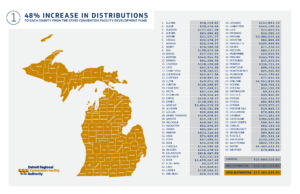
By allowing the authority to issue additional debt for improvements, the bills do something significant for counties. Beginning in 2023, the baseline allocation in liquor tax dollars for counties will increase by approximately 48 percent — or $25 million. (See county-by-county estimates.) The annual increase will remain the same as current law of 1 percent additional each year, but the baseline will be reset every three years to reflect the increase in revenue from the liquor tax.

Also, current law states 50 percent of the liquor tax revenue received by counties must be allocated to substance abuse programs. SBs 1222-23 will change that requirement to 40 percent (though no less than the amount allocated in FY22). In short, this will be a significant increase in funds toward substance abuse programs and an increase in the amount counties can allocate to their general funds. 

The bills are now headed to the governor for her expected signature.

For more information on this issue, contact Deena Bosworth at bosworth@micounties.org.

DUI for Alcohol or Marijuana or Prescription Drugs - Fight it

More Posts

3‑D Printed Marijuana Breathalyzer Prototype

3‑D Printed Marijuana Breathalyzer Prototype

Key Takeaways 2021 NIJ research found that THC levels in blood, urine, or oral fluid do not correlate with impairment, and field sobriety tests fail to detect cannabis intoxication. 2023 VCU research (DOJ‑funded) began developing a colorimetric THC breathalyzer…

read more…
Frequently Asked Questions about Restoring Your Driver's License in Michigan

FAQs About Restoring Your Drivers License in Michigan

Frequently Asked Questions about Restoring Your Driver’s License in Michigan Here’s what you need to know What are the steps to restore my driver’s license in Michigan? The steps to restore your driver’s license in Michigan vary depending on the reason your license…

read more…
Adult-Use Marijuana Tax Payments Being Distributed to Michigan cities for the millions of dollars taken in tax money for marijuana sales.

Cannabis Tax Payments Being Distributed in Michigan

Adult-Use Marijuana Tax Payments Being Distributed In Michigan Here’s what they say… Treasury: Adult-Use Marijuana Payments Being Distributed to Michigan Municipalities and Counties; More Than $59.5 Million Going to 224 Municipalities and Counties. Sales of “legal”…

read more…
Is collecting taxes on federally illegal businesses is a conspiracy and CCE

Trulieve seeks $143M federal refund for 280E taxes

Would enforcing payment and accepting money from a federally illegal business cause you to be caught up in RICO, CCE and conspiracy charges that would put you away for decades? For you yes – For the government a big NO. Have you been arrested or charged for any…

read more…
Trulieve seeks $143M federal refund for 280E taxes

Trulieve seeks $143M federal refund for 280E taxes

Would enforcing payment and accepting money from a federally illegal business cause you to be caught up in RICO, CCE and conspiracy charges that would put you away for decades? For you yes – For the government a big NO.

Multistate marijuana company Trulieve Cannabis Corp. is currently seeking a federal tax refund amounting to $143 million. The company firmly maintains that it does not owe the taxes it had diligently paid over a span of three years.

“This determination is supported by legal interpretations that challenge the company’s tax liability under Section 280E of the Internal Revenue Code,” Florida-based Trulieve announced through a recent news release.

Section 280E poses a significant obstacle for state-legal marijuana companies, as it prohibits them from deducting their standard business expenses. Consequently, these companies are burdened with substantially increased tax bills.

26 U.S. Code § 280E – Expenditures in connection with the illegal sale of drugs

No deduction or credit shall be allowed for any amount paid or incurred during the taxable year in carrying on any trade or business if such trade or business (or the activities which comprise such trade or business) consists of trafficking in controlled substances (within the meaning of schedule I and II of the Controlled Substances Act) which is prohibited by Federal law or the law of any State in which such trade or business is conducted.

More Posts

3‑D Printed Marijuana Breathalyzer Prototype

3‑D Printed Marijuana Breathalyzer Prototype

Key Takeaways 2021 NIJ research found that THC levels in blood, urine, or oral fluid do not correlate with impairment, and field sobriety tests fail to detect cannabis intoxication. 2023 VCU research (DOJ‑funded) began developing a colorimetric THC breathalyzer…

read more…
Frequently Asked Questions about Restoring Your Driver's License in Michigan

FAQs About Restoring Your Drivers License in Michigan

Frequently Asked Questions about Restoring Your Driver’s License in Michigan Here’s what you need to know What are the steps to restore my driver’s license in Michigan? The steps to restore your driver’s license in Michigan vary depending on the reason your license…

read more…
Adult-Use Marijuana Tax Payments Being Distributed to Michigan cities for the millions of dollars taken in tax money for marijuana sales.

Cannabis Tax Payments Being Distributed in Michigan

Adult-Use Marijuana Tax Payments Being Distributed In Michigan Here’s what they say… Treasury: Adult-Use Marijuana Payments Being Distributed to Michigan Municipalities and Counties; More Than $59.5 Million Going to 224 Municipalities and Counties. Sales of “legal”…

read more…
Is collecting taxes on federally illegal businesses is a conspiracy and CCE

Trulieve seeks $143M federal refund for 280E taxes

Would enforcing payment and accepting money from a federally illegal business cause you to be caught up in RICO, CCE and conspiracy charges that would put you away for decades? For you yes – For the government a big NO. Have you been arrested or charged for any…

read more…
IRS report predicts national rise in cannabis industry tax audits.

IRS report predicts national rise in cannabis industry tax audits.

A recently released report from a branch of the U.S. Treasury Department states the Internal Revenue Service is preparing to launch an increase in marijuana industry audits nationwide, However, it also offers a possible way for marijuana companies to skirt federal taxes.

The IRS is closely monitoring the marijuana industry and intends to target companies that have failed to pay their full federal tax obligations.The agency has plans to enforce the collection of those taxes.

The report – written by the Treasury Inspector General for Tax Administration (TIGTA) – found there are likely hundreds of millions of dollars in unpaid taxes owed by the marijuana industry under Section 280E of the Internal Revenue Code, which prohibits standard business deductions by companies that traffic in federally illegal drugs, including marijuana.

26 U.S. Code § 280E.Expenditures in connection with the illegal sale of drugs

No deduction or credit shall be allowed for any amount paid or incurred during the taxable year in carrying on any trade or business if such trade or business (or the activities which comprise such trade or business) consists of trafficking in controlled substances (within the meaning of schedule I and II of the Controlled Substances Act) which is prohibited by Federal law or the law of any State in which such trade or business is conducted.

Definition of Controlled Substance Schedules

Drugs and other substances that are considered controlled substances under the Controlled Substances Act (CSA) are divided into five schedules. An updated and complete list of the schedules is published annually in Title 21 Code of Federal Regulations (C.F.R.) §§1308.11 through 1308.15. Substances are placed in their respective schedules based on whether they have a currently accepted medical use in treatment in the United States, their relative abuse potential, and likelihood of causing dependence when abused. Some examples of the drugs in each schedule are listed below.

Schedule I Controlled Substances

Substances in this schedule have no currently accepted medical use in the United States, a lack of accepted safety for use under medical supervision, and a high potential for abuse.

Some examples of substances listed in Schedule I are: heroin, lysergic acid diethylamide (LSD), marijuana (cannabis), peyote, methaqualone, and 3,4-methylenedioxymethamphetamine ("Ecstasy").

Schedule II/IIN Controlled Substances (2/2N)

Substances in this schedule have a high potential for abuse which may lead to severe psychological or physical dependence.

Examples of Schedule II narcotics include: hydromorphone (Dilaudid®), methadone (Dolophine®), meperidine (Demerol®), oxycodone (OxyContin®, Percocet®), and fentanyl (Sublimaze®, Duragesic®).  Other Schedule II narcotics include: morphine, opium, codeine, and hydrocodone.

Examples of Schedule IIN stimulants include: amphetamine (Dexedrine®, Adderall®), methamphetamine (Desoxyn®), and methylphenidate (Ritalin®).

Other Schedule II substances include: amobarbital, glutethimide, and pentobarbital.

Farmington Hills, MI-based Attorney Michael Komorn who has represented the medical marijuana businesses and recreational cannabis licensing and legal defense stated “Here they come like we knew they would... so now is the time to prepare.”

Recent Posts