Michigan cherishes the Second Amendment, but it’s important to remember that this right isn’t absolute. Certain actions or circumstances can lead to its temporary or permanent loss. Understanding these situations and potential avenues for restoration is crucial for responsible gun ownership.
Losing Your Second Amendment Rights in Michigan:
Felony Convictions: Committing a felony automatically disarms you under both state and federal law (MCL 750.223c). The types of felonies affecting gun rights vary, encompassing violent crimes, drug offenses, and even some white-collar misdeeds.
Domestic Violence Convictions: A misdemeanor domestic violence conviction can strip you of your gun rights for three years (MCL 750.223c(1)(c)). While a first-time misdemeanor offense with deferred sentencing might not result in a conviction, it still triggers a gun rights suspension.
Mental Health Adjudications: Being involuntarily committed for mental illness or deemed a danger to yourself or others can also lead to temporary gun rights loss (MCL 330.1463). This typically involves legal proceedings and evaluations by qualified professionals.
Protective Orders: A judge issuing a personal protection order (PPO) against you due to domestic violence or stalking can also temporarily suspend your gun rights (MCL 600.8455).
Restoring Your Second Amendment Rights:
Felony Conviction Restoration: While federal law offers limited restoration options, Michigan allows individuals to petition the court for gun rights restoration five years after completing sentences for most felonies (MCL 750.223c(5)). The court considers various factors like rehabilitation and public safety concerns before making a decision.
Domestic Violence Restoration: Restoration after a domestic violence conviction requires waiting three years and demonstrating the absence of further domestic violence incidents (MCL 750.223c(1)(c)). Additionally, completing anger management or domestic violence treatment programs may strengthen your case.
Mental Health Adjudication Restoration: Once the underlying mental health concerns are addressed and deemed no longer a risk, individuals can petition the court to reinstate their gun rights (MCL 330.1463). This typically involves providing medical documentation and expert evaluations.
Protective Order Restoration: If the PPO against you expires or is lifted by the court, your gun rights are automatically restored. However, violating a PPO can have serious legal consequences, including additional gun rights restrictions.
This post provides a general overview and isn’t a substitute for legal advice.
If you face gun rights restriction or seek restoration, consulting with a qualified attorney familiar with Michigan gun laws is highly recommended.
By understanding the potential limitations and restoration processes, responsible gun owners in Michigan can safeguard their Second Amendment rights and exercise them safely and lawfully.
Restore Your Rights
Driver License Gun License Professional License Record Expungement
Thank You... and have a nice day eh!Disclaimer: We are not Attorneys in Canada. This is an article of information obtained from various sources and presented here. We can only assume they are accurate. If you ever find a reason to go to Canada and need a lawyer...we...
If it's got a motor, it's a BUIWe got lakes, we got boats, we got alcohol, we got cannabis all the fun you can possibly find on a holiday weekend in the summer. Just don't combine them all or you'll be calling us or your cousin Vinny. Operating a Boat Under the...
Can I drink alcohol and smoke cannabis if I'm canoeing or kayaking or tubing or paddleboarding or just floating around?While Michigan law doesn't explicitly forbid consuming alcohol on non-motorized vessels like canoes or kayaks, it's strongly discouraged for safety...
Michigan Workers and the Right to Protest: Can They Force a Change in Business Strategy?The ever-evolving economic landscape can create friction between Michigan workers and their employers. Workers may find themselves at odds with company strategies or investments,...
Summary from the official government website (Link Below)The Use of Tetrahydrocannabinol Is Associated with an Increase in Survival Time in Palliative Cancer Patients: A Retrospective Multicenter Cohort StudyThe study, conducted by researchers in Germany, analyzed...
Proposed Rule Seeks to Move Marijuana from Schedule I to Schedule III, Emphasizing its Currently Accepted Medical Use in Treatment in the United StatesThe Justice Department announced today that the Attorney General has initiated a formal rulemaking process to...
JUSTICE.GOVFor Immediate Release Office of Public AffairsA federal jury convicted a Michigan doctor today for causing the submission of over $6.3 million in fraudulent claims to Medicare for medically unnecessary orthotic braces ordered through a telemarketing...
The Impact of Marijuana Reclassification on Legal LandscapeOn May 6, 2024, the DEA made a groundbreaking decision, accepting the US Department of Health and Human Services' recommendation to reclassify marijuana from Schedule I to Schedule III controlled substance....
AP StoryPresident Joe Biden may potentially ban TikTok, but he aims to offer young individuals, who largely influence this widely-used social media platform, a more lenient government regulation regarding marijuana. Facing a decline in support from an important...
Qualified lower-paid workers who earn a salary but work more than 40 hours in a week will soon be entitled to guaranteed time-and-a-half pay, thanks to a new labor rule announced by the Biden-Harris administration. This rule will raise the salary thresholds necessary...
With the next election season, Michigan Democrats passed a new law that allows 16-year-old high school students in the state to pre-register to vote.
“Michigan led the nation in youth voter turnout in the 2022 elections and we are working to build on that progress in 2024,” said Michigan Secretary of State Jocelyn Benson. “This new law helps us prepare the next generation of voters to inherit their democracy, bolstering our state’s commitment to engaging young people, educating them about the democratic process, and getting them ready to cast a ballot once they turn 18. I’m proud of the work we’ve done to energize Michigan’s young voters and look forward to implementing this policy to continue to make elections accessible for everyone.”
The law permits 16-year-olds to pre-register, as the Michigan Department of Education collaborates with the Secretary of State to ensure eligibility and material coordination.
Minimum Wage Increase
On January 1, 2024 Michigan’s minimum wage will increase from $10.10 to $10.33.
Another raise coming on Jan. 1, 2025, to establish the state’s minimum wage at $10.56.
For tipped workers, the minimum wage will increase to $3.93 per hour, up from $3.84.
The State law requires that, when tips are received, the combined tip and hourly rate must equal the required minimum hourly wage.
Michigan’s Gun Laws
A package of gun laws was introduced in Lansing, intended to help protect people from gun violence.
Michigan Democrats were able to buse their power obtained in the 2022 elections to get the three bills through both the House and Senate and onto the desk of Governor Gretchen Whitmer.
Safe Storage: If you own a gun or if a minor is expected to be in your home, a gun owner will be required to lock their weapon away
Background checks: Someone purchasing a firearm at a gun show or through a private sale will need to have their background checked regardless of how they are buying it
‘Red flag’: establish a pathway for extreme risk protection orders – intended to remove the potential of violence for those who may have mental health problems or have threatened others.
In February, Michigan’s right-to-work law will be repealed, marking a significant milestone as the state becomes the first in decades to overturn a union-restricting law known as “right-to-work,” which was enacted over a decade ago by a Republican-controlled Legislature.
The state’s “right-to-work” law, which allowed individuals in unionized workplaces to opt out of paying union dues and fees, has been repealed. This repeal is celebrated as a significant triumph for organized labor, especially considering the record-low union membership rates experienced last year. No dues and fees – no contributions.
The Democratic lawmakers pushed through the repeal, which Whitmer said would restore workers’ rights and protect Michiganders on the job.
Michigan expands Elliot-Larsen Act
Whitmer signed an expansion of the Elliot-Larsen Act – which includes protection from discrimination based on sexual orientation or gender identity/expression.
The act safeguards the rights of individuals within the LGBTQ+ community concerning employment, housing, education, and access to accommodations.
Michigan repeals third-grade reading law
Whitmer has also taken action by signing a bill that repeals Michigan’s third-grade reading law, which was implemented in 2016 due to the fact that less than half of Michigan third graders achieved a passing score on the reading section of M-Step..
In 2016, the state of Michigan enacted a law that required schools to identify students who were struggling with reading and writing. The law would hold students behind for a year if they are more than one grade level behind.
That law ends in 2024.
Starting next year, students will not be held back if they receive a low score. Instead, parents will receive information about intervention options.
Michigan’s bold energy plan
It has been a seven-year journey, but Michigan now proudly presents its ambitious clean energy plan, with the goal of achieving 100% clean energy by 2040.
In late November, Whitmer signed the historic Clean Energy & Climate Action Package.
The legislation aims to enhance clean energy production by utilizing specific government mechanisms. This includes granting the Michigan Public Service Commission the authority to spearhead large-scale solar power projects, a role previously undertaken by local governments.
The state has set ambitious targets for its energy production in the coming years. By 2040, the goal is to generate all of its energy from clean sources. To make this vision a reality, the state has established milestones of achieving 50% clean energy by 2030 and 60% by 2035. Currently, the state derives 12% of its energy from renewable sources, primarily wind.
The act goes into place on Feb. 27, 2024.
RESTORE YOUR SECOND AMENDMENT RIGHTS RESTORE YOUR PROFESSIONAL LICENSE RESTORE YOUR DRIVER LICENSE RESTORE YOUR PAST (Expungements)
Call our Office for a free case evaluation Komorn Law (248) 357-2550
Thank You... and have a nice day eh!Disclaimer: We are not Attorneys in Canada. This is an article of information obtained from various sources and presented here. We can only assume they are accurate. If you ever find a reason to go to Canada and need a lawyer...we...
If it's got a motor, it's a BUIWe got lakes, we got boats, we got alcohol, we got cannabis all the fun you can possibly find on a holiday weekend in the summer. Just don't combine them all or you'll be calling us or your cousin Vinny. Operating a Boat Under the...
Can I drink alcohol and smoke cannabis if I'm canoeing or kayaking or tubing or paddleboarding or just floating around?While Michigan law doesn't explicitly forbid consuming alcohol on non-motorized vessels like canoes or kayaks, it's strongly discouraged for safety...
Michigan Workers and the Right to Protest: Can They Force a Change in Business Strategy?The ever-evolving economic landscape can create friction between Michigan workers and their employers. Workers may find themselves at odds with company strategies or investments,...
Summary from the official government website (Link Below)The Use of Tetrahydrocannabinol Is Associated with an Increase in Survival Time in Palliative Cancer Patients: A Retrospective Multicenter Cohort StudyThe study, conducted by researchers in Germany, analyzed...
Proposed Rule Seeks to Move Marijuana from Schedule I to Schedule III, Emphasizing its Currently Accepted Medical Use in Treatment in the United StatesThe Justice Department announced today that the Attorney General has initiated a formal rulemaking process to...
JUSTICE.GOVFor Immediate Release Office of Public AffairsA federal jury convicted a Michigan doctor today for causing the submission of over $6.3 million in fraudulent claims to Medicare for medically unnecessary orthotic braces ordered through a telemarketing...
The Impact of Marijuana Reclassification on Legal LandscapeOn May 6, 2024, the DEA made a groundbreaking decision, accepting the US Department of Health and Human Services' recommendation to reclassify marijuana from Schedule I to Schedule III controlled substance....
AP StoryPresident Joe Biden may potentially ban TikTok, but he aims to offer young individuals, who largely influence this widely-used social media platform, a more lenient government regulation regarding marijuana. Facing a decline in support from an important...
Qualified lower-paid workers who earn a salary but work more than 40 hours in a week will soon be entitled to guaranteed time-and-a-half pay, thanks to a new labor rule announced by the Biden-Harris administration. This rule will raise the salary thresholds necessary...
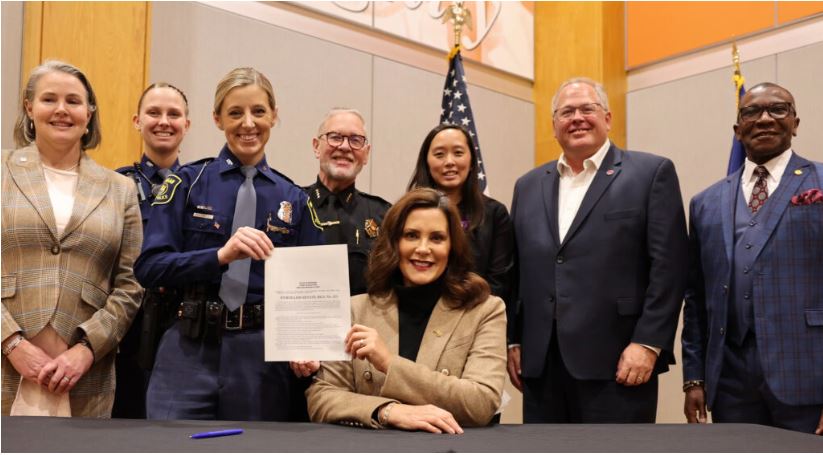
Gov. Gretchen Whitmer proudly showcases a crucial bipartisan gun violence bill package that she recently signed into law, underscoring her unwavering dedication to safeguarding the lives of those vulnerable to domestic violence. This essential measure reflects the governor’s commitment towards protecting those in need.
The bills aim to prevent individuals convicted of misdemeanor domestic violence from buying, having, or carrying firearms for a period of eight years after their sentence.
According to an analysis by the Michigan House Fiscal Agency, House Bill 4945 aims to update the sentencing guidelines, preventing individuals convicted of domestic violence from purchasing or possessing firearms or ammunition for a duration of eight years.
The bill aims to broaden the definition of a felony, expanding the range of crimes resulting in individuals being prohibited from possessing, using, or transferring firearms or ammunition for three years after completing their sentence.
Senate Bill 471 renders illegal firearm and ammunition possession by individuals convicted of misdemeanor domestic violence.
According to Senate Legislative Analysis, SB 471 would broaden the scope of felony possession prohibitions to include offenses punishable by more than one year but less than four years of imprisonment, committed under the laws of other states and the United States.
But the bills also cover a wide range of nonviolent offenses and misdemeanors, including breaking into vending machines and parking meters, tampering with electronic tethers, occupying properties without permission, causing pollution, illegally recording in a movie theater, and engaging in joyriding.
All in all, these bills enforce restrictions on the possession and sale of firearms and ammunition in over 100 legal situations unrelated to domestic violence.
According to an analysis by the Michigan House Fiscal Agency, House Bill 4945 aims to update the sentencing guidelines, preventing individuals convicted of domestic violence from purchasing or possessing firearms or ammunition for a duration of eight years.
The bill aims to broaden the definition of a felony, expanding the range of crimes resulting in individuals being prohibited from possessing, using, or transferring firearms or ammunition for three years after completing their sentence.
Senate Bill 471 renders illegal firearm and ammunition possession by individuals convicted of misdemeanor domestic violence.
According to Senate Legislative Analysis, SB 471 would broaden the scope of felony possession prohibitions to include offenses punishable by more than one year but less than four years of imprisonment, committed under the laws of other states and the United States.
RESTORE YOUR GUN RIGHTS RESTORE YOUR PROFESSIONAL LICENSE RESTORE YOU DRIVER LICENSE RESTORE YOUR FUTURE
Call Our Office for a Free Case Evaluation Komorn Law (248) 357-2550
DISCLAIMER This post may contain re-posted content, opinions, comments, ads, third party posts, outdated information, posts from disgruntled persons, posts from those with agendas and general internet BS. Therefore…Before you believe anything on the internet regarding anything – do your research on Official Government and State Sites, Call the Michigan State Police, Check the State Attorney General Website and Consult an Attorney – Use Your Brain.
A federal circuit judge writes that Detroit’s vehicle seizure scheme
“is simply a money-making venture—one most often used to extort money from those who can least afford it.”
A panel of federal appellate judges ruled that Detroit’s practice of seizing people’s cars for months before allowing them to contest the seizure violates vehicle owners’ 14th Amendment right to due process.
The U.S. Court of Appeals for the 6th Circuit, agreeing with a lower U.S. district court, found that Michigan’s Wayne County, which includes Detroit,
“violated that Constitution when it seized plaintiffs’ personal vehicles—which were vital to their transportation and livelihoods—with no timely process to contest the seizure.”
The 6th Circuit’s ruling mandates that Wayne County must conduct a court hearing for car owners post-seizure within a two-week timeframe.
Wayne County will probably spend two weeks looking for a loophole.
When facing legal challenges, particularly in criminal cases, it is advisable to seek legal counsel immediately.
An experienced attorney can provide guidance on how to navigate interactions with law enforcement while safeguarding your constitutional rights.
Since 1993 our expert legal defense in navigating criminal law matters and protecting your constitutional rights are what we eat for breakfast everyday.
The "automobile exception" in Michigan law allows police to search a vehicle without a warrant if they have probable cause to believe it contains evidence of a crime.This exception is grounded in the idea that vehicles are inherently mobile, meaning evidence could be...
The US Supreme Court and Federal Gun Law CasesChallenges to Federal Gun Laws the right of the people to keep and bear Arms, shall not be infringed Updated July 8, 2024 Ratified in 1791, the Second Amendment provides, “A well regulated Militia, being necessary to the...
FAQs and Laws about Cybercrime and Financial FraudThe digital age has brought unprecedented convenience, but it has also opened new avenues for criminals to commit financial fraud and cybercrime. In Michigan, as elsewhere, individuals and businesses face increasing...
Conversion of Funds by Fraud in MichiganThe fraudulent conversion of funds or property, often referred to as embezzlement or obtaining money by false pretenses, is a serious criminal offense in Michigan. These crimes involve a breach of trust where an individual...
Open WideRecent news reports from July 2025 indicate that the Michigan House of Representatives approved bills (House Bills 4390 and 4391) that would allow for roadside saliva testing (also known as oral fluid analysis) for drivers suspected of being under the...
Michigan Implements Substantial Medical Debt Forgiveness ProgramGovernor Gretchen Whitmer has announced a significant initiative to alleviate the burden of medical debt for nearly 210,000 Michigan residents, totaling over $144 million in forgiven obligations. This...
Tale of Two Cases - Maybe ThreeExamining Justice in Michigan's Cannabis Landscape Michigan's progressive stance on cannabis, marked by the legalization of both medical and recreational marijuana, has been lauded as a significant step forward. However, recent...
Why Healthcare Costs So Much and is Poor QualityState and federal prosecutors have charged more than 320 people and uncovered nearly $15 billion in false claims in what they described Monday as the largest coordinated takedown of health care fraud schemes in Justice...
An Analysis of People of MI v. Julia Kathleen Soto: Application of Marijuana Regulation and Taxation Act to Felony ChargesMichigan has made headlines for legalizing recreational marijuana, but this doesn't mean all marijuana-related activities are now legal. The case...
Michigan's cannabis industry is facing significant headwinds, from oversupply and falling prices to persistent illicit market activity. In a recent public meeting, Brian Hanna, the executive director of the Michigan Cannabis Regulatory Agency (CRA), made a clear and...
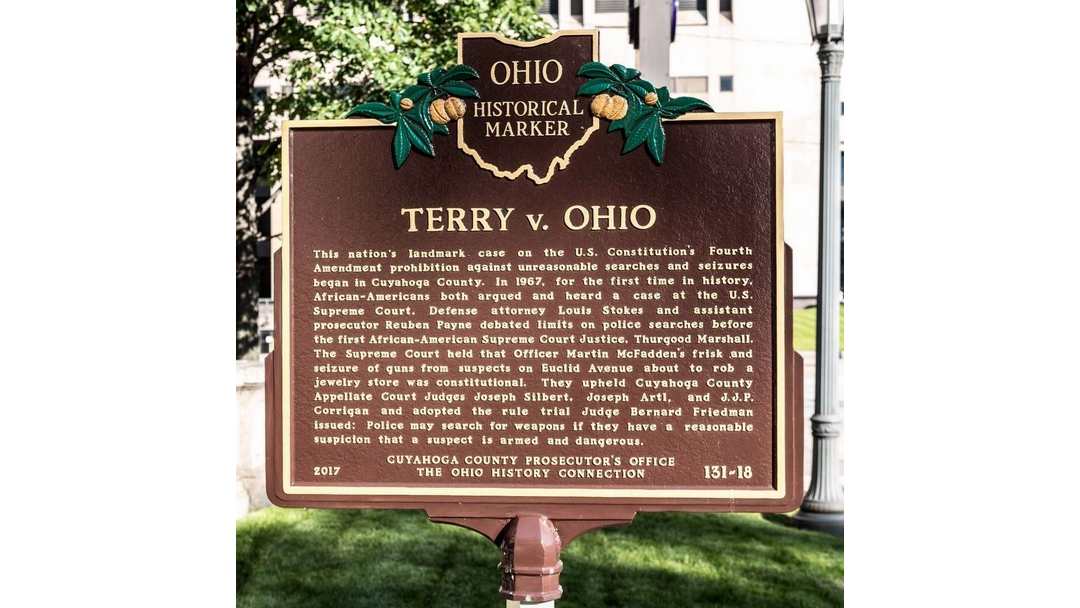
On October 31, 1963 while conducting his regular patrol in downtown Cleveland, seasoned Cleveland Police detective Martin McFadden, who brought 39 years of law enforcement experience to the job, observed three men behaving suspiciously as they paced back and forth in front of a jewelry store located on Euclid Avenue.
Concerned that the men were planning a robbery and possibly armed, McFadden identified himself as a police officer and inquired about their names. When the men merely mumbled their responses, McFadden conducted a frisk, discovering a pistol in John W. Terry’s overcoat pocket and a revolver in Richard Chilton’s coat pocket.
The unarmed third man, Katz, was noted in the incident where McFadden apprehended and charged Terry and Chilton for carrying concealed weapons. Judge Bernard Friedman of the Cuyahoga County Common Pleas Court subsequently found the defendants guilty, deeming that the suspicious behavior displayed by the men, coupled with McFadden’s genuine concern for his safety, justified the decision to conduct a frisk. This ruling was later upheld by the appeals court. In 1967, Terry brought the case before the U.S. Supreme Court.
Attorney Michael Komorn
State / Federal Legal Defense
With extensive experience in criminal legal defense since 1993 from pre-arrest, District, Circuit, Appeals, Supreme and the Federal court systems.
In June 1968, the United States Supreme Court affirmed the conviction and set a precedent that allows police officers to interrogate and frisk suspicious individuals without probable cause for an arrest, providing that the officer can articulate a reasonable basis for the stop and frisk.
Significantly, Terry does not provide blanket authority to intrude on an individual’s right to be left alone, nor does it allow such intrusion based on a police offers inarticulate hunch that a crime is about to occur or is in progress.
However, it does radically expand police authority to investigate crimes where there is a reasonable basis for suspicion.
When facing legal challenges, particularly in criminal cases, it is advisable to seek legal counsel immediately.
An experienced attorney can provide guidance on how to navigate interactions with law enforcement while safeguarding your constitutional rights.
Since 1993 our expert legal defense in navigating criminal law matters and protecting your constitutional rights are what we eat for breakfast everyday.
Taxed Again..? They're working on it.A newly introduced Michigan House bill would impose a 32% excise tax on smartphones, tablets, gaming systems, and other internet‑connected devices marketed to or primarily used by minors. Lawmakers backing the proposal argue the...
No Second Amendment Rights For YouIf you are charged with a crime you're part of the State of Michigan family now. Call us - Because you don't want to be a part of that family. Komorn Law (248) 357-2550A federal judge in Michigan has ruled that a man with a prior...
A federal appeals court has ruled that the ban preventing people who use marijuana from possessing firearms is unconstitutional. The U.S. Court of Appeals for the Fifth Circuit concluded that the historical context of the Second Amendment’s original 1791 ratification did not justify disarming individuals based on past drug usage.
The decision is the latest in a series of successful challenges to the long-standing federal prohibition, which is actively being contested in various court cases across the country.
A three-judge panel for the Fifth Circuit Court of Appeals decided on Wednesday to toss the conviction of Patrick Daniels, a Mississippi man arrested and sentenced to prison for possessing firearms as an unlawful user of marijuana. The panel found that Daniels’ conviction was inconsistent with the “history and tradition” of gun regulation.
“In short, our history and tradition may support some limits on an intoxicated person’s right to carry a weapon, but it does not justify disarming a sober citizen based exclusively on his past drug usage,” Judge Jerry E. Smith, a Ronald Reagan appointee, wrote for the unanimouspanel inUS v. Daniels.
“Nor do more generalized traditions of disarming dangerous persons support this restriction on nonviolent drug users. As applied to Daniels, then, § 922(g)(3) violates the Second Amendment.”
RESTORE YOUR GUN RIGHTS – CALL OUR OFFICE – KOMORN LAW (248) 357-2550
Kimberly Golden Gore, an attorney for Daniels, similarly said during an oral argument in June that her client was “serving 46 months in a federal facility for having less than half a gram of marijuana, and two firearms that otherwise would have been legal,” arguing that “historical tradition simply doesn’t support that kind of permanent and total restriction on his Second Amendment rights.”
This ruling potentially invalidates the firearms ban for any person who is an “unlawful user” of any illicit drug, not just marijuana.
DISCLAIMER In a legal environment that continues to evolve, it is essential to stay informed and seek guidance from knowledgeable professionals. Before acting on any information you find on the internet, this website, any linked website, any referring website or any verbal or written information consult a licensed attorney. Contact Komorn Law today to discuss your case and learn how we can assist you in navigating the complexities of Michigan’s laws. Consult an Attorney – Remember you’re on the internet.
DISCLAIMER In a legal environment that continues to evolve, it is essential to stay informed and seek guidance from knowledgeable professionals. Before acting on any information you find on the internet, this website, any linked website, any referring website or any verbal or written information consult a licensed attorney. Contact Komorn Law today to discuss your case and learn how we can assist you in navigating the complexities of Michigan’s laws. Consult an Attorney – Remember you’re on the internet.