“It won’t be until 2020 until a state government can have a state plan for raising industrial hemp in their state,” said James Averill, deputy director for MDARD.

The Industrial Hemp Growers Act contains important information regarding registration fees,
application deadlines, and notification requirements.
This DOCUMENT highlights the numbers, deadlines, and dates included in the Act.
These figures are accurate as of March 7, 2022 and are subject to change.
More information about crop-related requirements below can be found at
www.Michigan.gov/HempLaws
On October 21, 2021, the Michigan Department of Agriculture and Rural Development (MDARD) received federal approval of the revised Michigan Hemp Production Plan dated October 18, 2021.
The plan contains regulatory requirements for cultivating industrial hemp and maintains MDARD as having primary oversight of industrial hemp production in Michigan. This latest U.S. Department of Agriculture approval was required to ensure Michigan’s plan complies with the USDA’s final rule.
Michigan’s first approved state plan went into effect December 1, 2020 and aligned with USDA’s Interim Final Rule requirements.
The USDA issued its Final Rule on January 15, 2021 after review of 5,900 comments which went into effect March 22, 2021, Within that short window, Governor Gretchen Whitmer signed Senate Bill 0816, sponsored by Senator Dan Lauwers (R-Brockway Township), which updated Michigan’s Industrial Hemp Growers Act (Public Act 220 of 2020) to ensure the state’s cultivation law agreed with updated requirements in USDA’s final hemp rule.
Because Michigan was able to quickly update Public Act 220 and implement it this year, hemp growers will not see a change to requirements they’ve become familiar with this season. This latest USDA approval simply brings the state plan up to date with the Final Rule and Public Act 220.
MDARD expects to regularly revisit the Industrial Hemp Growers Act as the state’s program evolves. The industry develops, and federal policies are modified. Any changes to the state hemp program require USDA approval, so MDARD expects this review and approval process to happen on a recurring basis. All state and tribe plans can be viewed on USDA’s website.


BMMR cannabis corruption. prosecutors dispensary Driving DUI educational FAQs forfeiture gun rights hemp komornlaw lara law enforcement abuse laws Legalization marijuana Medical Marijuana Michigan Michigan Court of Appeals michigan laws michigan news michigan supreme court MMFLA news politics science usa news us supreme court Your Rights
DISCLAIMER
This post may contain re-posted content, opinions, comments, ads, third party posts, outdated information, posts from disgruntled persons, posts from those with agendas and general internet BS. Therefore…Before you believe anything on the internet regarding anything – do your research on Official Government and State Sites, Call the Michigan State Police, Check the State Attorney General Website and Consult an Attorney – Use Your Brain.
Michigan officials are informing citizens that food and drinks with CBD oil aren’t legal yet. CBD is the new thing in the health alternative market.
After Proposal 1 passed in Michigan which legalized adult-use marijuana and industrial hemp as well as the 2018 U.S. Farm Bill which legalized hemp nationwide there has been a rise of products made with CBD.
“The whole scheme is fascinating. It doesn’t make the subject matter into an illegality,” said Michael Komorn, a lawyer and president of the Michigan Medical Marijuana Association. “It’s a not a crime, it’s a regulatory fine. You won’t get arrested, but it may prevent you from getting a license to do that in the future.”
Michigan's Department of Agriculture and Rural Development is waiting on the federal government to write its hemp program regulations before it comes up with its own rule set -- and that won't happen until 2020.
“It won’t be until 2020 until a state government can have a state plan for raising industrial hemp in their state,” said James Averill, deputy director for MDARD.
However, a mechanism in the 2014 Farm Bill that allows farmers to grow industrial hemp by working with universities or with state departments of agriculture -- and Averill said Michigan is considering a way to help farmers plant hemp sooner rather than later.
“For putting seed in the ground this year -- we have to work off the 2014 Farm Bill and that is a conversation that we’re continuing to have with the administration,” Averill said.
Previously, U.S. Drug Enforcement Administration requirements made the state’s direct involvement to authorize hemp farmers difficult. The 2018 Farm Bill changed that, Averill said.
Michigan Offers Guidance on CBD and Industrial Hemp
March 29, 2019 – The Bureau of Marijuana Regulation (BMR) and the Michigan Dept of Agriculture & Rural Development (MDARD) issued joint guidance today regarding CBD (cannabidiol) and industrial hemp.
From the Bureau of Marijuana Regulation:
From the Michigan Department of Agriculture and Rural Development:
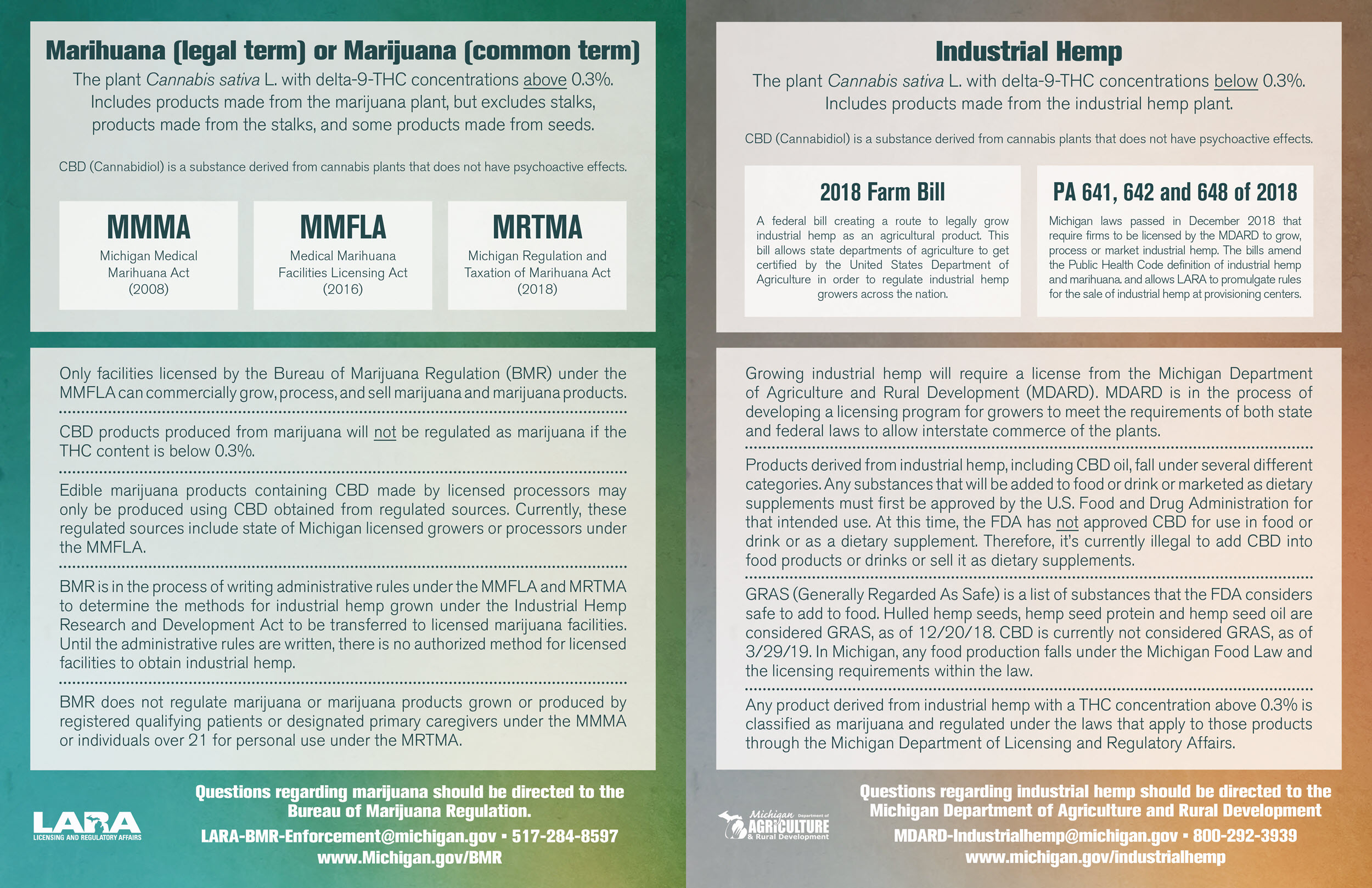
Definitions
Michigan officials are informing citizens that food and drinks with CBD oil aren’t legal yet. CBD is the new thing in the health alternative market.
After Proposal 1 passed in Michigan which legalized adult-use marijuana and industrial hemp as well as the 2018 U.S. Farm Bill which legalized hemp nationwide there has been a rise of products made with CBD.
“The whole scheme is fascinating. It doesn’t make the subject matter into an illegality,” said Michael Komorn, a lawyer and president of the Michigan Medical Marijuana Association. “It’s a not a crime, it’s a regulatory fine. You won’t get arrested, but it may prevent you from getting a license to do that in the future.”
Michigan's Department of Agriculture and Rural Development is waiting on the federal government to write its hemp program regulations before it comes up with its own rule set -- and that won't happen until 2020.
“It won’t be until 2020 until a state government can have a state plan for raising industrial hemp in their state,” said James Averill, deputy director for MDARD.
However, a mechanism in the 2014 Farm Bill that allows farmers to grow industrial hemp by working with universities or with state departments of agriculture -- and Averill said Michigan is considering a way to help farmers plant hemp sooner rather than later.
“For putting seed in the ground this year -- we have to work off the 2014 Farm Bill and that is a conversation that we’re continuing to have with the administration,” Averill said.
Previously, U.S. Drug Enforcement Administration requirements made the state’s direct involvement to authorize hemp farmers difficult. The 2018 Farm Bill changed that, Averill said.
Michigan Offers Guidance on CBD and Industrial Hemp
March 29, 2019 – The Bureau of Marijuana Regulation (BMR) and the Michigan Dept of Agriculture & Rural Development (MDARD) issued joint guidance today regarding CBD (cannabidiol) and industrial hemp.
From the Bureau of Marijuana Regulation:
From the Michigan Department of Agriculture and Rural Development:
Definitions