
This case is about whether the Act’s general prohibition on the sale and possession of certain “assault weapons,” are unconstitutional under the Second Amendment.
An en banc federal appeals court upheld Maryland’s ban on assault-style weapons in a 10-5 decision Tuesday.
The 4th U.S. Circuit Court of Appeals in Richmond, Virginia, ruled that military-style weapons are not shielded by the Second Amendment as they are intended for prolonged combat scenarios and do not align with the requirements for self-defense.
– Define self defense and what is one defending, a home, a family. a city, a nation and against whom, a single person, a mob, an invasion? –
Judge J. Harvie Wilkinson III authored the majority opinion, with the support of eight other justices, while a tenth justice expressed agreement with the outcome.

The 4th Circuit previously upheld the Maryland law in a 2017 decision, but the U.S. Supreme Court rejected part of the appeals court’s approach when it ruled in a different 2022 case, New York State Rifle & Pistol Association Inc. v. Bruen, according to the appeals court.
In the new decision, Wilkinson concluded that the 2013 Maryland law
“fits comfortably within our nation’s tradition of firearms regulation.”
The Fourth Circuit ruled in favor of the state, agreeing that AR-15-style weapons are military-style firearms that are not protected by the Second Amendment
even though the second amendment states
“A well regulated Militia, being necessary to the security of a free State, the
right of the people to keep and bear Arms , shall not be infringed.”
Maryland enacted its assault weapons ban in 2013 after a shooter used a semi-automatic rifle in the 2012 mass killing of 20 children and six adults at Sandy Hook Elementary School in Newtown, Connecticut.
The 2013 law is an example of states regulating “excessively dangerous weapons” when their “incompatibility with a lawful and safe society becomes apparent,” he wrote.
In his dissent, Judge Julius N. Richardson said the Second Amendment “is not a second-class right subject to the whimsical discretion of federal judges. Its mandate is absolute and, applied here, unequivocal.” His dissent was joined by four other judges.
Read more here
What’s going on out there…
- Colorado clerk urges Supreme Court to block trial over voting machine password leak
Former Mesa County clerk-recorder Tina Peters claims she has constitutional immunity from prosecution by “hostile state actors.” - Montana Supreme Court finds parental consent law unconstitutional
Montana minors have a right to make reproductive health care decisions privately, without parental interference, the justices ruled. - No bonus for growing weed
A marijuana farm worker cannot win his breach-of-contract suit over a $100,000 bonus he says he’s owed for achieving a “healthy harvest of 1,400 pounds of dry cannabis crop.” The contract is void and unenforceable because “manufacturing” marijuana is a federal crime. - Matthew Perry’s assistant among 5 people, including 2 doctors, charged in ‘Friends’ star’s death
Meanwhile back at the ranch…

Legal Counsel and Your Rights
When facing legal challenges, particularly in criminal cases, it is advisable to seek legal counsel immediately.
An experienced attorney can provide guidance on how to navigate interactions with law enforcement while safeguarding your constitutional rights.
Since 1993 our expert legal defense in navigating criminal law matters and protecting your constitutional rights are what we eat for breakfast everyday.
Contact Komorn Law PLLC if you’re ready to fight and win.
Research us and then call us.
More Rights You Should Know

Supreme Court to Hear Case on Gun Rights and Marijuana Use
Supreme Court to Hear Case on Gun Rights and Marijuana Use The Supreme Court has agreed to hear U.S. v. Hemani, a case challenging the federal ban on gun ownership by individuals who use marijuana—even in states where it’s legal. The decision could reshape how drug...
Supreme Court Declines to Hear Maryland Gun Permit Case
The U.S. Supreme Court recently declined to hear Snope v. Brown, a case challenging Maryland’s requirement for a permit to carry a concealed handgun. While the Court offered no explanation, the decision leaves in place a lower court ruling that upheld the state’s...
Other Articles

What does Nolle Prosequi mean?
What does Nolle Prosequi mean? Fatal Flaw In criminal cases, nolle prosequi may be employed when there is a significant weakness in the prosecution's case, when the prosecutor acknowledges an inability to prove the charges, or even when the prosecutor has lost...

People v. Lukity, 460 Mich 484 (1999)
Case Summary The Michigan Supreme Court reversed the Court of Appeals and reinstated the defendant’s conviction for first-degree criminal sexual conduct against his fourteen‑year‑old daughter. The Court held that although one evidentiary error occurred, it was...

Motion in Limine vs Motion to Suppress
Defininition and Explaination - Motion in LimineOverview Although both a motion in limine and a motion to suppress deal with evidence, they serve very different purposes in Michigan criminal cases. Understanding the distinction is critical because each motion affects...
A Motion in Limine – What does it Mean?
Defininition and Explaination - Motion in LimineA motion in limine is a pretrial request asking the judge to exclude (or sometimes allow) specific evidence before the jury ever hears it. It’s one of the most important evidentiary tools in both criminal and civil...

Michigan Supreme Court and Court of Appeals Cases – Threat of Terrorism
Case Summary In People v Kvasnicka, the defendant sent a message to a young girl stating she “would not be laughing” when he came to her school to “shoot it up or blow it up like Columbine.” Charged under Michigan’s threat‑of‑terrorism statute, he argued the law was...
What is a Franks Hearing?
What is a Frank's Hearing?A Franks hearing is a critical legal tool used when a defendant claims that police lied, exaggerated, or recklessly disregarded the truth in a search warrant affidavit. When law enforcement places its hand on the Constitution, the law...

Michigan House Bill Proposes 32% Tax on Internet Devices for Kids
Taxed Again..? They're working on it.A newly introduced Michigan House bill would impose a 32% excise tax on smartphones, tablets, gaming systems, and other internet‑connected devices marketed to or primarily used by minors. Lawmakers backing the proposal argue the...
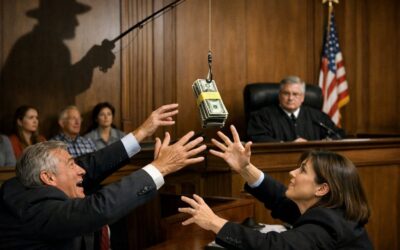
Shadow cash is corrupting Michigan courtrooms
The Shadow Cash Threat: Protecting the Integrity of Michigan Courtrooms In recent months, a spotlight has been cast on a hidden influence within the Michigan legal system: "shadow cash." This term refers to third-party litigation funding (TPLF), where outside...