
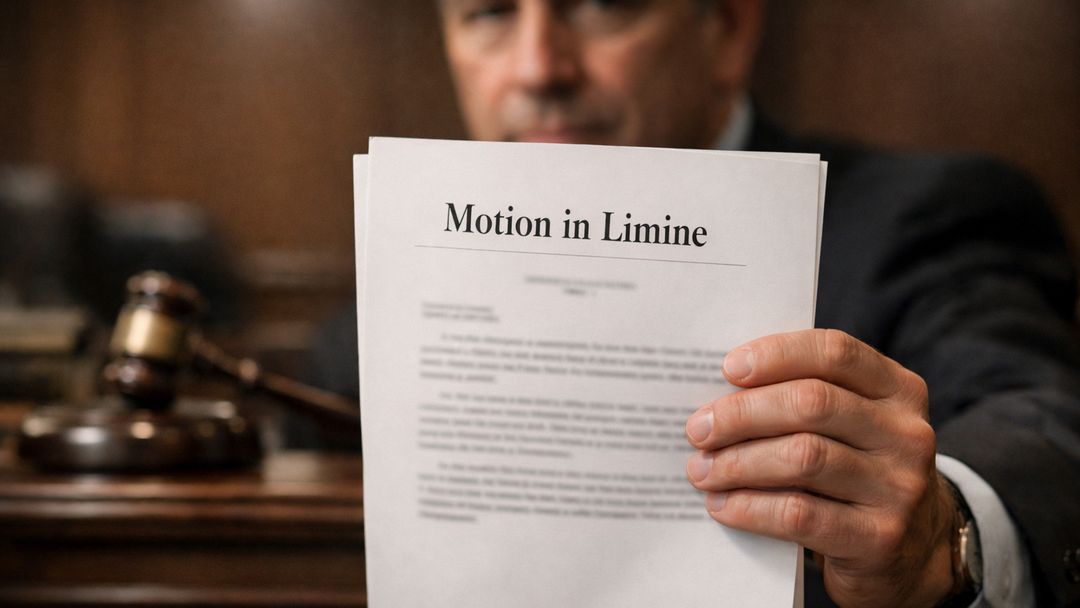
Defininition and Explaination – Motion in Limine
A motion in limine is a pretrial request asking the judge to exclude (or sometimes allow) specific evidence before the jury ever hears it. It’s one of the most important evidentiary tools in both criminal and civil litigation.
-
A motion in limine is filed before trial begins, usually at or before the final pretrial conference.
-
The phrase comes from Latin meaning “at the threshold” — because the issue is decided before the jury crosses the threshold into the courtroom.
-
Its purpose is to prevent the jury from being exposed to prejudicial, irrelevant, or inadmissible evidence that could unfairly influence the verdict.
-
The judge rules on the motion outside the presence of the jury.
Why Lawyers Use Motions in Limine
-
To exclude damaging evidence that the opposing party might try to introduce.
-
To avoid “bell that can’t be unrung” situations, where even a brief mention of improper evidence could taint the jury.
-
To streamline the trial by resolving evidentiary disputes in advance.
-
To preserve issues for appeal by creating a clear record of what was objected to and why.
What a Motion in Limine Can Address
Common targets include:
-
Prior criminal history
-
Allegations not supported by admissible evidence
-
Hearsay statements
-
Speculative or inflammatory claims
-
Irrelevant personal information
-
Improper expert testimony
-
References to plea negotiations or insurance coverage
A motion in limine can also be affirmative, asking the court to allow certain evidence that might otherwise be challenged.
How Courts Handle These Motions
-
The judge reviews the motion, any response, and applicable rules of evidence.
-
The ruling may be:
-
Granted (evidence excluded)
-
Denied (evidence allowed)
-
Reserved (judge waits to see how the evidence comes up at trial)
-
-
If granted, no one may mention the excluded evidence in front of the jury without first obtaining permission outside the jury’s presence.
Why It Matters
A motion in limine can dramatically shape the trial. Keeping prejudicial or irrelevant information away from the jury protects the defendant’s right to a fair trial and keeps the focus on legally admissible evidence.
If you want, I can turn this into a full website article with headings, FAQs, citations, SEO meta description, and schema — just say the word.
Common Issues Addressed in Motions in Limine
Attorneys use motions in limine to challenge or pre‑approve evidence such as:
-
Prior criminal history or bad acts (MRE 404(b))
-
Hearsay statements (MRE 801–803)
-
Speculative or inflammatory allegations
-
Improper expert testimony (MRE 702)
-
References to plea negotiations (MRE 410)
-
Insurance coverage or settlement discussions
-
Irrelevant personal information A motion in limine may also be affirmative, asking the court to allow evidence that may otherwise be challenged.
How Michigan Courts Decide These Motions
Judges typically hear motions in limine at the final pretrial conference or immediately before trial. The court may:
-
Grant the motion (evidence excluded)
-
Deny the motion (evidence allowed)
-
Reserve ruling until the evidence arises at trial If granted, the parties must not reference the excluded evidence in front of the jury without first obtaining permission outside the jury’s presence. Violating a granted motion in limine can result in a mistrial or sanctions.
Impact on Trial Strategy
A well‑crafted motion in limine can dramatically shape the trial. By controlling what the jury hears, attorneys can focus the case on admissible, relevant evidence and prevent the opposing party from injecting improper or prejudicial material. In criminal cases, these motions are often essential to protecting the defendant’s constitutional rights and ensuring a fair trial.
Since 1993, Komorn Law, PLLC has aggressively defended clients in Michigan courts, from district court to the federal level. Our firm has extensive experience litigating evidentiary issues, including motions in limine, suppression motions, and constitutional challenges. If you are facing criminal charges or need strategic pretrial advocacy, contact us at 248‑357‑2550 or visit > KomornLaw.com
Motion in Limine FAQs
Q: What does “motion in limine” literally mean?
A: It means “at the threshold,” referring to decisions made before the trial begins.
Q: When is a motion in limine filed?
A: Typically before trial, often at or before the final pretrial conference.
Q: Is a motion in limine the same as an objection?
A: No. An objection happens during trial; a motion in limine resolves evidentiary issues before trial.
Q: What happens if someone violates a granted motion in limine? A: The judge may issue sanctions, strike testimony, or declare a mistrial depending on the severity.
Q: Can a motion in limine be used to admit evidence?
A: Yes. Parties may file motions seeking pre‑approval of evidence likely to be challenged.
More

Coalition Forms to Support Voter Approved MRTMA
New Coalition Forms To Support Voter Approved Cannabis ActMichigan’s adult‑use cannabis framework was not created by accident. It was built through a deliberate, voter‑driven process culminating in the Michigan Regulation and Taxation of Marihuana Act (MRTMA). The Act...

Michigan Court of Appeals Orders City of Taylor to Release Police Misconduct Records
Case Summary The Michigan Court of Appeals has ruled that the City of Taylor must comply with a Freedom of Information Act (FOIA) request submitted by the ACLU of Michigan seeking police misconduct records dating back to 2021. The request covers documents involving...

Michigan Supreme Court and Court of Appeals Cases – Home Invasion
Case Summary In People v Berry, the defendant co‑owned a home with his former partner. After moving out and negotiating a buyout, he re‑entered the home with another individual before the agreement was finalized. Both were charged with first‑degree home invasion. The...

Cannabis Regulators Association-Briefing on Marijuana Schedule Change
Overview of the President’s December 18th Executive Order and the Implications When Marijuana is Rescheduled to Schedule III under the U.S. Controlled Substances ActTOP-LINE SUMMARY The President signed an Executive Order on December 18, 2025, ordering his...

Trump’s Marijuana Reclassification 2025
Donald Trump’s Actions On December 18, 2025, President Donald Trump signed an executive order reclassifying marijuana from a Schedule I to a Schedule III controlled substance under the federal Controlled Substances Act (CSA). This marks the most significant federal...

Michigan Supreme Court and Court of Appeals Cases – Felon in Possession
Case Summary In People v Hughes, the defendant challenged Michigan’s felon‑in‑possession statute on Second Amendment grounds. He argued the law was unconstitutional both on its face and as applied to nonviolent offenders. The Court of Appeals rejected both...

Michigan Supreme Court and Court of Appeals Cases – Controlled Substances
Case Summary In People v Soto (COA) the defendant faced a felony charge after an 85‑pound shipment of marijuana was delivered to her home. She argued that the Michigan Regulation and Taxation of Marihuana Act (MRTMA) shielded her from felony prosecution because the...

Michigan Supreme Court and Court of Appeals Cases – Confessions
Case Summary Michigan courts issued several important decisions clarifying when confessions are admissible, how Miranda applies in nontraditional settings, and what constitutes a valid invocation of counsel. In Lafey, a spontaneous statement made during a pat‑down was...

Fourth Amendment Search & Seizure — A Quick Summary
Fourth Amendment Search & Seizure — Quick Summary The Fourth Amendment protects individuals from unreasonable searches and seizures, limiting when and how the government may intrude on privacy. These protections apply only when police conduct qualifies as a search...

Marijuana Under Fire in Michigan
Marijuana in Michigan is facing renewed challenges as lawmakers push for higher taxes and regulatory changes that critics argue undermine the voter-approved legalization of 2018. Court battles, legislative maneuvers, and industry pushback highlight the tension between...