
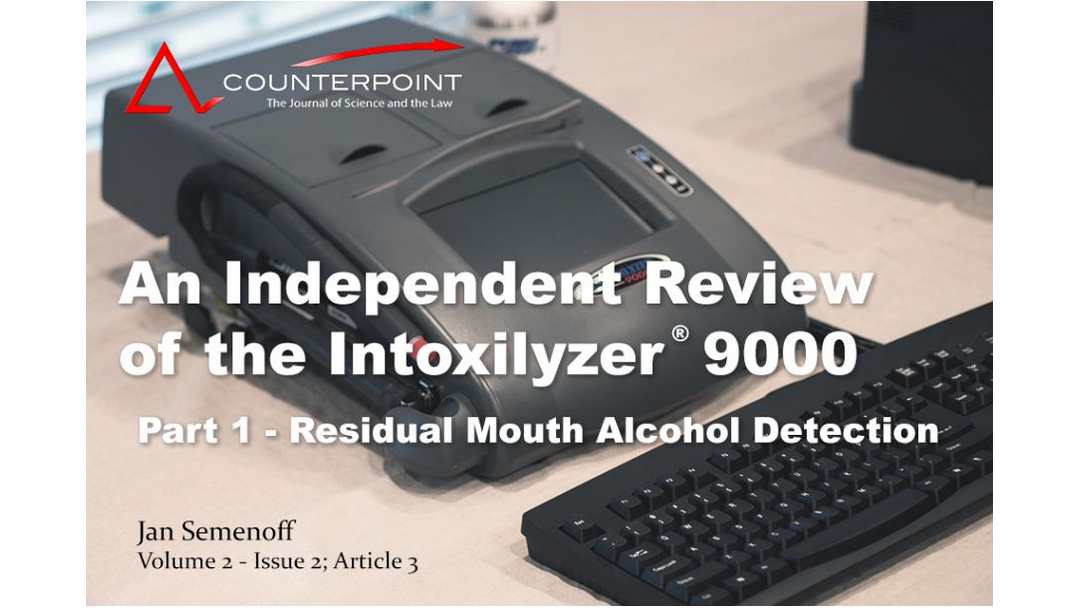
An Independent Review of the Intoxilyzer 9000
Part 1 – Residual mouth alcohol detection
Counterpoint Volume 2; Issue 2 – Article 3 (August 2017)
An article in the Core Skills III-2 Module
Jan Semenoff, BA, EMA
Forensic Criminalist
The opportunity to conduct an independent analysis and performance review of a new breath alcohol testing device is rare, particularly the higher-end, evidentiary-level units.
Access to these technologies is stringently controlled by both their manufacturers and the police and government agencies that control them.
Additionally, state agencies are often reluctant to publish the results of their official assessments and analysis of the devices.
When given the opportunity to perform such a review on a new Intoxilyzer 9000, I designed a series of experiments to quickly analyze the overall performance of the device.
I attended the device’s location with colleague Tom Workman (1948 – 2019) to determine its suitability and reliability in a number of key areas, including:
- Overall design and ease of use
- Accuracy in determining in vitro [2] BrAC levels using a simulator
- The ability of the device to determine the presence of Fresh Mouth Alcohol using a Residual
- Alcohol Detection System (RADS) or the so-called “slope detector”.
- Reliability in reporting BrAC [3] readings that are highly specific to ethanol
- The effect of Radio Frequency Interference on the device [4]
This article will provide a general overview of the operational characteristics of the Intoxilyzer 9000. We will additionally look at the apparent accuracy of the device using simulator readings, and examine the ability of the device to “flag” false positive reading caused by fresh mouth alcohol contamination.

Read the rest of Part One here
Parts two and three are in the drop down menu at the site but not easy to notice. The links are below if you have trouble.
Part Two and Part Three will examine the unit’s specificity towards ethanol detection and its ability to identify the presence of an interferent chemical, and the capacity of the device to detect Radio Frequency Interference.
Related Articles
No Results Found
The page you requested could not be found. Try refining your search, or use the navigation above to locate the post.
More Posts

Vehicle Forfeiture in Canada – The Process of Taking
Thank You... and have a nice day eh!Disclaimer: We are not Attorneys in Canada. This is an article of information obtained from various sources and presented here. We can only assume they are accurate. If you ever find a reason to go to Canada and need a lawyer...we...

Boating in Michigan on Alcohol and Drugs – It’s Illegal
If it's got a motor, it's a BUIWe got lakes, we got boats, we got alcohol, we got cannabis all the fun you can possibly find on a holiday weekend in the summer. Just don't combine them all or you'll be calling us or your cousin Vinny. Operating a Boat Under the...

Alcohol, Drugs, Kayaking – It could be a problem
Can I drink alcohol and smoke cannabis if I'm canoeing or kayaking or tubing or paddleboarding or just floating around?While Michigan law doesn't explicitly forbid consuming alcohol on non-motorized vessels like canoes or kayaks, it's strongly discouraged for safety...

Michigan Workers Right to Protest – Can They Force a Change in Business Strategy?
Michigan Workers and the Right to Protest: Can They Force a Change in Business Strategy?The ever-evolving economic landscape can create friction between Michigan workers and their employers. Workers may find themselves at odds with company strategies or investments,...

THC Associated with Increase of Survival Time in Palliative Cancer
Summary from the official government website (Link Below)The Use of Tetrahydrocannabinol Is Associated with an Increase in Survival Time in Palliative Cancer Patients: A Retrospective Multicenter Cohort StudyThe study, conducted by researchers in Germany, analyzed...

Justice Department Submits Proposal to Reschedule Marijuana
Proposed Rule Seeks to Move Marijuana from Schedule I to Schedule III, Emphasizing its Currently Accepted Medical Use in Treatment in the United StatesThe Justice Department announced today that the Attorney General has initiated a formal rulemaking process to...

Bloomfield Hills Doctor Convicted of $6M Medicare Fraud Scheme
JUSTICE.GOVFor Immediate Release Office of Public AffairsA federal jury convicted a Michigan doctor today for causing the submission of over $6.3 million in fraudulent claims to Medicare for medically unnecessary orthotic braces ordered through a telemarketing...

The Legal Significance of Marijuana Reclassification
The Impact of Marijuana Reclassification on Legal LandscapeOn May 6, 2024, the DEA made a groundbreaking decision, accepting the US Department of Health and Human Services' recommendation to reclassify marijuana from Schedule I to Schedule III controlled substance....

A historic cannabis shift is one of the latest election year moves
AP StoryPresident Joe Biden may potentially ban TikTok, but he aims to offer young individuals, who largely influence this widely-used social media platform, a more lenient government regulation regarding marijuana. Facing a decline in support from an important...

New rule mandates time and a half pay for lower paid employees
Qualified lower-paid workers who earn a salary but work more than 40 hours in a week will soon be entitled to guaranteed time-and-a-half pay, thanks to a new labor rule announced by the Biden-Harris administration. This rule will raise the salary thresholds necessary...