
Students and 4th Amendment Rights
Students are entitled to a right to be safe from unreasonable searches and seizures even within school premises, as ruled by the Supreme Court of the United States.
However, these rights are somewhat limited for students, allowing school officials to conduct searches based on reasonable suspicion rather than just probable cause.
Reasonable Suspicion – The standard that must be met in order to search a student at school; this criterion was established by in 1985 by the case New Jersey v. T.L.O.
Case Background
In a New Jersey high school, a teacher caught two girls smoking in the bathroom and escorted them to the principal’s office. While one girl confessed to smoking, the other, identified as T.L.O., denied it.
The principal discovered that the girl was also selling marijuana at school when they inspected her purse. T.L.O. confessed to the offense after being brought to the police station.
Based on her confession and the evidence in her purse, the state of New Jersey brought charges against her. In a juvenile court, T.L.O. argued that her Fourth Amendment rights against unreasonable searches and seizures had been violated.
The school was supported by the court, but T.L.O. appealed to the New Jersey Supreme Court, which ultimately deemed the search unreasonable and the evidence inadmissible.
The state of New Jersey appealed the decision to the United States Supreme Court.

US Supreme Court Decision
School administrators are not required to obtain a search warrant or establish probable cause
In 1985, the Supreme Court ruled, by a 6-3 margin, that New Jersey and the school had met a “reasonableness” standard for conducting such searches at school.
School administrators are not required to obtain a search warrant or establish probable cause before conducting searches, as students have a decreased expectation of privacy while on school premises.
Legal Counsel and Your Rights
When facing legal challenges, particularly in criminal cases, it is advisable to seek legal counsel immediately.
An experienced attorney can provide guidance on how to navigate interactions with law enforcement while safeguarding your constitutional rights.
Since 1993 our expert legal defense in navigating criminal law matters and protecting your constitutional rights are what we eat for breakfast everyday.
Contact Komorn Law PLLC if you’re ready to fight and win.
Research us and then call us.
CONSTITUTION OF MICHIGAN OF 1963
§ 11 Searches and seizures.
Sec. 11.
The person, houses, papers, possessions, electronic data, and electronic communications of every person shall be secure from unreasonable searches and seizures. No warrant to search any place or to seize any person or things or to access electronic data or electronic communications shall issue without describing them, nor without probable cause, supported by oath or affirmation.
The provisions of this section shall not be construed to bar from evidence in any criminal proceeding any narcotic drug, firearm, bomb, explosive or any other dangerous weapon, seized by a peace officer outside the curtilage of any dwelling house in this state.
History: Const. 1963, Art. I, § 11, Eff. Jan. 1, 1964 ;– Am. S.J.R. G, approved Nov. 3, 2020, Eff. Dec. 19, 2020
Constitutionality: The last sentence of this section was held invalid as in conflict with US Const, Am IV. Lucas v People, 420 F2d 259 (CA 6, 1970); Caver v Kropp, 306 F Supp 1329 (DC Mich 1969); People v Pennington, 383 Mich 611; 178 NW2d 460 (1970); People v Andrews, 21 Mich App 731; 176 NW2d 460 (1970).
Former Constitution: See Const. 1908, Art. II, § 10.
Recent

Michigan Supreme Court and Court of Appeals Cases – Threat of Terrorism
Case Summary In People v Kvasnicka, the defendant sent a message to a young girl stating she “would not be laughing” when he came to her school to “shoot it up or blow it up like Columbine.” Charged under Michigan’s threat‑of‑terrorism statute, he argued the law was...
What is a Franks Hearing?
What is a Frank's Hearing?A Franks hearing is a critical legal tool used when a defendant claims that police lied, exaggerated, or recklessly disregarded the truth in a search warrant affidavit. When law enforcement places its hand on the Constitution, the law...
Other Articles
Listen Live to the US Supreme Court
Listen live to arguments in the Supreme Court. On Monday, the Supreme Court is set to hear arguments over the phone for the first time ever due to the coronavirus pandemic; they'll hear 10 cases remotely from now until May 13. But that's not the only history being...

US Supreme Court Press Releases Regarding the Justices and counsel will all participate remotely.
The US Supreme Court will hear oral arguments by telephone conference on May 4, 5, 6, 11, 12 and 13 in a limited number of previously postponed cases. The following cases will be assigned argument dates after the Clerk’s Office has confirmed the availability of...
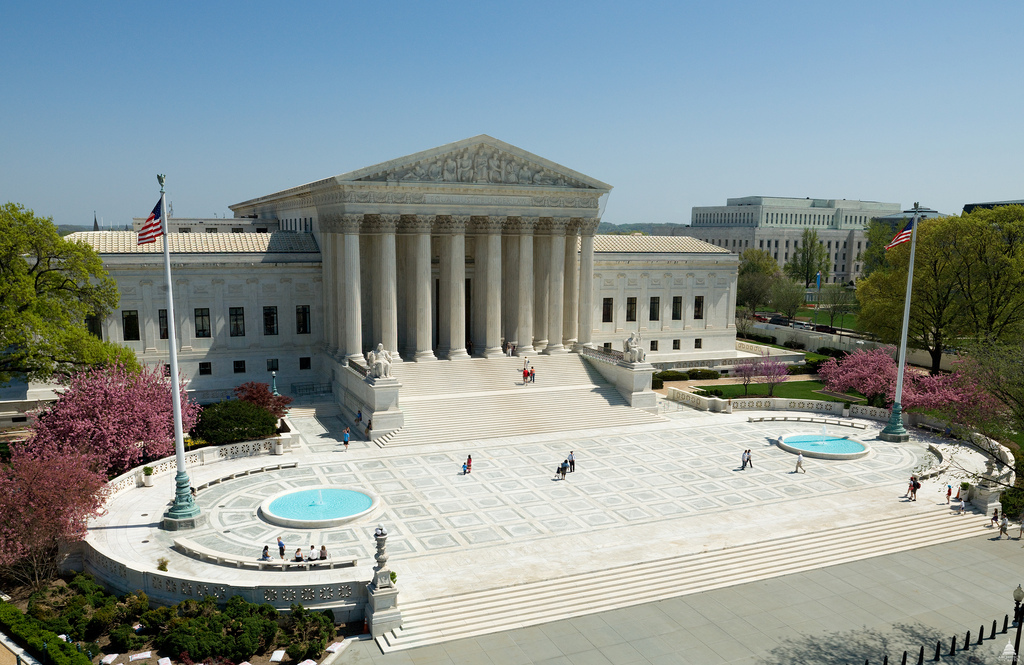
US Supreme Court – knock-and-announce rule
SUPREME COURT OF THE UNITED STATES BOOKER T. HUDSON, Jr., PETITIONER v. MICHIGAN [June 15, 2006] Justice Scalia delivered the opinion of the Court, except as to Part IV. We decide whether violation of the “knock-and-announce” rule requires the suppression of...

Planet Green Trees Radio Episode 149-MSC People v. Koon
The best resource for everything related to Michigan medical marijuana with your host Attorney Michael Komorn. Live every Thursday evening from 8 -10 pm eastern time. By Michael Komorn The Michigan Supreme Court issued a unanimous opinion making a finding that...