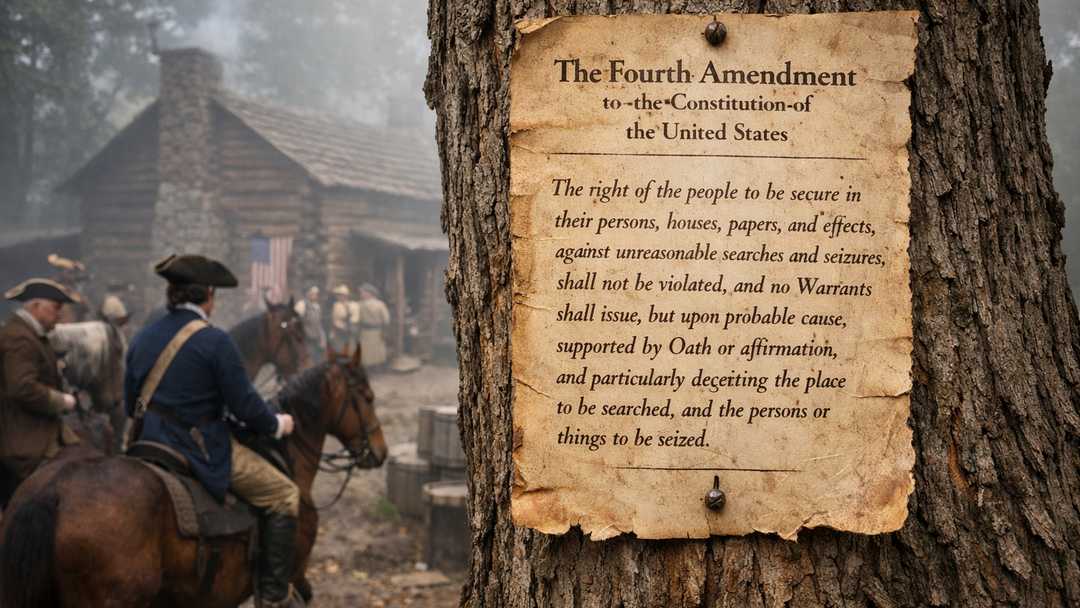
Fourth Amendment Search & Seizure — Quick Summary
The Fourth Amendment protects individuals from unreasonable searches and seizures, limiting when and how the government may intrude on privacy. These protections apply only when police conduct qualifies as a search or seizure. A search occurs when the government violates a person’s reasonable expectation of privacy, a standard drawn from Katz v. United States. This includes accessing private digital data or using technology like thermal imaging. There is no protection for things exposed to the public or left in open fields. A seizure involves meaningful interference with property or a situation where a reasonable person would not feel free to leave
Most searches and seizures require probable cause, meaning facts that would lead a reasonable person to believe a crime occurred or that evidence will be found. Probable cause is required for a warrant, which must be issued by a neutral judge, supported by sworn evidence, and describe the place and items with particularity
Although warrants are preferred, several exceptions allow warrantless searches:
-
Search incident to arrest (limited to the arrestee and immediate area)
-
Consent (must be voluntary and within the scope granted)
-
Plain view (officer lawfully present and the item’s illegality is obvious)
-
Exigent circumstances (emergencies like hot pursuit or imminent danger)
-
Automobile exception (probable cause to search a vehicle)
If police violate the Fourth Amendment, the Exclusionary Rule bars illegally obtained evidence. The related fruit of the poisonous tree doctrine excludes derivative evidence as well, ensuring constitutional compliance and deterring misconduct
Komorn Law, founded in 1993, brings decades of seasoned experience to Michigan’s most complex criminal and regulatory matters, including the evolving cannabis framework from the MMMA to today’s MRTMA landscape. The firm represents clients facing controlled‑substance offenses, DUI and drug‑related driving charges, firearm violations, property crimes, resisting or obstructing, and the most serious allegations such as manslaughter and homicide. With a proven record in courts across Michigan and the federal system, Komorn Law delivers strategic, relentless advocacy when the stakes are highest. To work with a firm that truly refuses to back down, call 248-357-2550.
Frequently Asked Questions (FAQs)
1. What does the Fourth Amendment protect me from?
The Fourth Amendment protects you from unreasonable searches and seizures by the government. This means police generally need a valid legal basis—such as a warrant or a recognized exception—to search you, your home, your car, or your belongings.
2. When do police need a warrant?
A warrant is required when police want to search an area where you have a reasonable expectation of privacy, such as your home. A warrant must be supported by probable cause, issued by a neutral judge, and must clearly describe the place to be searched and items to be seized.
3. What counts as “probable cause”?
Probable cause means there are enough facts to make a reasonable person believe that a crime has occurred or that evidence of a crime will be found in the place to be searched. It’s more than a hunch but less than proof beyond a reasonable doubt.
4. Are there exceptions that allow police to search without a warrant?
Yes. Common exceptions include:
-
Consent (you voluntarily agree)
-
Search incident to arrest
-
Plain view (evidence is clearly visible)
-
Exigent circumstances (emergency situations)
-
Automobile exception (vehicles can be searched with probable cause) These exceptions allow warrantless searches when specific legal conditions are met.
5. What happens if police violate the Fourth Amendment?
Evidence obtained illegally may be excluded under the Exclusionary Rule, meaning it cannot be used against you in court. Additionally, the fruit of the poisonous tree doctrine may exclude evidence derived from the illegal search as well.
More Articles

Michigan Supreme Court and Court of Appeals Cases – Threat of Terrorism
Case Summary In People v Kvasnicka, the defendant sent a message to a young girl stating she “would not be laughing”...

Michigan Supreme Court and Court of Appeals Cases – Prisoner in Possession
Prisoner in Possession of a Controlled SubstanceCase Summary In People v Tadgerson, the Michigan Supreme Court...
Michigan Supreme Court and Court of Appeals Cases – Threat of Terrorism
Case Summary In People v Kvasnicka, the defendant sent a message to a young girl stating she “would not be laughing”...
What is a Franks Hearing?
What is a Frank's Hearing?A Franks hearing is a critical legal tool used when a defendant claims that police lied,...
More

Michigan Supreme Court and Court of Appeals Cases – Prisoner in Possession
Prisoner in Possession of a Controlled SubstanceCase Summary In People v Tadgerson, the Michigan Supreme Court addressed a critical question: does the crime of a prisoner possessing a controlled substance under MCL 800.281(4) require proof of intent, or is it a...

What is Inference Stacking?
What Is Inference Stacking? A Legal ExplanationInference stacking—also called pyramiding of inferences—is a rule of evidence that prohibits courts or juries from building one inference on top of another when the first inference is not supported by direct evidence....

Michigan Supreme Court and Court of Appeals Cases – Murder
Case Summary In People v Jones, the Michigan Court of Appeals addressed whether a single act of abuse can support convictions for both first‑degree child abuse and felony murder. The defendant argued that using the same conduct to support both charges violated...

Michigan Supreme Court and Court of Appeals Cases – Neglect of Duty
Case Summary In People v Harper, a Wayne County Sheriff’s deputy was charged with neglect of duty after witnessing an inmate escape during his smoke break and taking no action to stop or pursue the prisoner. The prosecution relied on the Sheriff’s Department policy...

Michigan Supreme Court and Court of Appeals Cases – Metallic Knuckles
Case Summary In People v Dummer, the defendant challenged Michigan’s metallic‑knuckles statute, arguing that simply possessing the weapon was protected by the Second Amendment. The Michigan Court of Appeals acknowledged that possession of metallic knuckles is...

Michigan Supreme Court and Court of Appeals Cases – Election Interference
Case Summary In People v Burkman, defendants created a robocall targeting African American voters during the 2020 election. The call falsely warned that mail‑in voting would expose voters to law‑enforcement tracking, debt collection, and forced vaccinations....