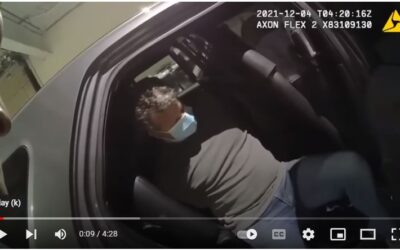

Mere presence in a “high crime” area does not provide particularized suspicion of criminal activity for an investigatory detention.
People vs Prude
In People v Prude, Prude was in a parked vehicle at an apartment complex that was regularly patrolled by police because of frequent reports of crimes committed by non-residents. Prude was observed by an officer sitting alone during daylight hours, with the engine off, in an area of the parking lot where criminal activity was common. No one else was in the area, and there was no evidence Prude’s vehicle was parked illegally or describing how long he had been parked in that location.
I’m outta here
An officer approached Prude, asked for identification, and inquired whether he was a resident of the complex. Although Prude declined to identify himself, he answered that he was not a resident but that he stayed at the complex with his girlfriend who was a resident. A second officer then arrived, approached Prude’s vehicle, and upon recognizing Prude, provided his name to the first officer.
The first officer then advised Prude he needed to be with a resident while on the property before returning to his patrol vehicle to verify Prude’s tenant status through LEIN and to check the complex’s internal database to see if Prude had previously received a trespass warning from the complex. When asked, the second officer advised Prude he was being detained and that he was not free to leave. Prude then started the vehicle, rolled up his window, and drove away at a high rate of speed.
Komorn Law (248) 357-2550
Criminal Defense | DUI | Traffic Tickets | Business | Family Law
In it to win it
Prude was later arrested, charged, and eventually convicted by a jury of second degree fleeing and eluding under MCL 257.602a(4), and assaulting, resisting, or obstructing a police officer under MCL 750.81d(1). The Court of Appeals affirmed Prude’s convictions. Prude sought leave to appeal where he argued that because both offenses required the prosecution to prove beyond a reasonable doubt the police acted lawfully (see People v Chapo and People v Moreno), the prosecution presented insufficient evidence the officers lawfully detained him based on a reasonable suspicion he was trespassing. The Michigan Supreme Court granted leave and without any oral argument, reversed Prude’s convictions and remanded the case to the trial court to enter judgments of acquittal.
The article is continued here: Terry Stop and Refusal to Identify Yourself to Police
Source: Legal Update 157 Mich.gov
Just goes to show – when you fight there’s a chance you can win.
Better call Komorn (248) 357-2550
More Posts
Sometimes our posts provide a general overview of things with opinionated sarcasm and dry humor by the writer to lighten the same old same old of other law sites. It does not substitute for legal advice. Anyone charged with a criminal offense should consult an attorney for specific legal guidance. BTW. True Fact: When Michael Komorn fights the justice system there is only one focus. You and your rights.

Recent
What is a Franks Hearing?
What is a Frank's Hearing?A Franks hearing is a critical legal tool used when a defendant claims that police lied, exaggerated, or recklessly disregarded the truth in a search warrant affidavit. When law enforcement places its hand on the Constitution, the law...

Michigan House Bill Proposes 32% Tax on Internet Devices for Kids
Taxed Again..? They're working on it.A newly introduced Michigan House bill would impose a 32% excise tax on smartphones, tablets, gaming systems, and other internet‑connected devices marketed to or primarily used by minors. Lawmakers backing the proposal argue the...
Related

Elder and Vulnerable Adult Financial Exploitation in Michigan
FAQs and Laws about Elder and Vulnerable Adult Financial ExploitationFinancial exploitation of elders and vulnerable adults is a growing and particularly insidious crime in Michigan, preying on individuals who, due to age, disability, or mental incapacity, are unable...

Sextortion and Sexploitation in Michigan
FAQs and Laws about Sextortion and SexploitationSextortion and sexploitation are increasingly prevalent and devastating forms of digital abuse, leveraging technology to coerce, manipulate, and exploit individuals, often for sexual gratification or financial gain....

Another look at People v Soto (MRTMA Defense Denied)
Another look at People v. Soto: Application of Marijuana Regulation and Taxation Act to Felony ChargesMichigan's cannabis landscape is evolving rapidly, marked by a nuanced exploration of the People v. Soto case and its implications for the Michigan Regulation and...

MSC has ruled against extensive warrantless searches of cell phones.
The Michigan Supreme Court recently issued a significant ruling on August 1, 2025, limiting the ability of law enforcement to conduct broad, warrantless searches of cell phones during criminal investigations.Summary The Michigan Supreme Court recently issued a...

Michigan State Police Bust $10 Million Marijuana Grow
Sometimes, a higher court needs to step in to ensure a lower court is properly administering justice. This powerful action is called "superintending control."Lake County, MI – In a significant enforcement action, the Michigan State Police (MSP) recently seized over...

Extortion and Racketeering in Michigan
FAQs and Laws about Extortion and RacketeeringExtortion and racketeering represent serious criminal offenses in Michigan, targeting individuals who use threats, intimidation, or participate in organized criminal enterprises to obtain money, property, or undue...