
Defininition and Explaination – Motion in Limine
Overview
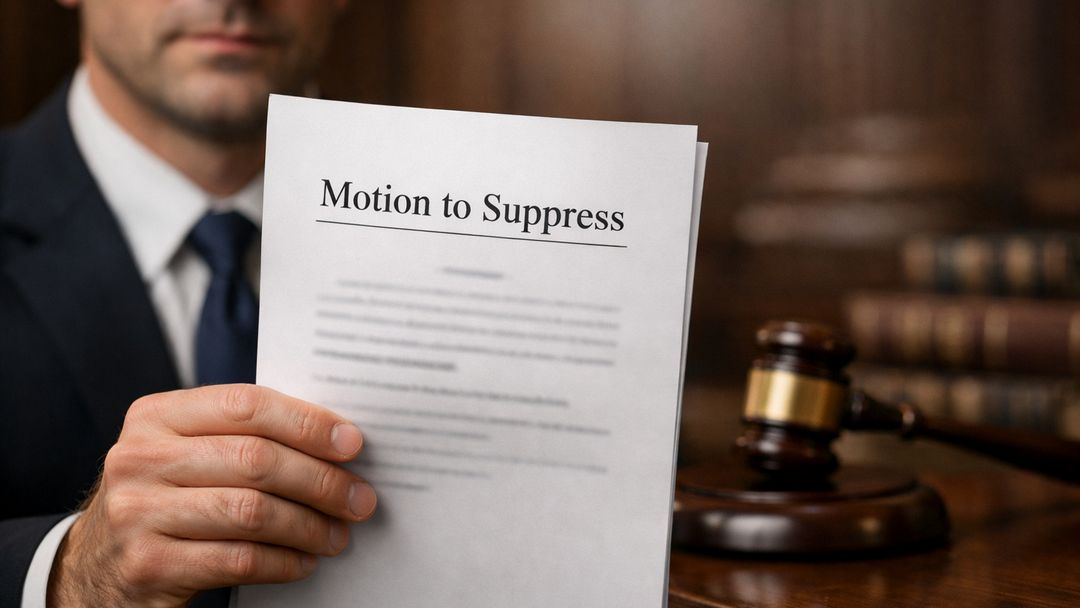
Although both a motion in limine and a motion to suppress deal with evidence, they serve very different purposes in Michigan criminal cases. Understanding the distinction is critical because each motion affects the trial in its own way and relies on different legal standards. Komorn Law regularly litigates both types of motions to protect clients’ constitutional rights and prevent improper evidence from reaching the jury.
What Is a Motion to Suppress?
A motion to suppress asks the court to exclude evidence because it was obtained in violation of a defendant’s constitutional rights. These motions typically involve:
- Fourth Amendment illegal searches or seizures
- Fifth Amendment violations (e.g., Miranda issues)
- Sixth Amendment right‑to‑counsel violations
- Unlawful traffic stops
- Invalid warrants
- Coerced statements If the court grants a motion to suppress, the evidence is completely barred from trial because it was unlawfully obtained. See Mapp v. Ohio, 367 U.S. 643 (1961) (exclusionary rule).
What Is a Motion in Limine?
A motion in limine is a pretrial request asking the judge to decide whether certain evidence should be excluded or allowed before the jury hears it. Unlike a motion to suppress, it does not depend on constitutional violations. Instead, it focuses on the Michigan Rules of Evidence, such as:
-
MRE 401–403 (relevance and prejudice)
-
MRE 404(b) (other‑acts evidence)
-
MRE 702 (expert testimony) A motion in limine is about trial fairness, not police misconduct.
Key Differences Between the Two Motions
Although both motions can keep evidence out of trial, they differ in purpose, timing, and legal basis:
| Issue | Motion to Suppress | Motion in Limine |
|---|---|---|
| Legal Basis | Constitutional violations | Michigan Rules of Evidence |
| Focus | Police conduct | Jury fairness & evidentiary rules |
| Timing | Usually early in the case | Typically right before trial |
| Effect | Evidence excluded entirely | Evidence excluded or limited at trial |
| Examples | Illegal search, Miranda violation | Prior bad acts, hearsay, prejudicial statements |
A motion to suppress challenges how evidence was obtained. A motion in limine challenges whether the jury should hear it.
Why Both Motions Matter in Criminal Defense
Strategic use of both motions can dramatically change the outcome of a case. A successful motion to suppress may eliminate key evidence, forcing the prosecution to reduce or dismiss charges. A motion in limine can prevent the jury from hearing damaging, irrelevant, or inflammatory information. Together, they help ensure a fair trial and protect constitutional rights.
Since 1993, Komorn Law, PLLC has aggressively defended clients in Michigan courts, litigating motions to suppress, motions in limine, and complex constitutional issues. If you are facing criminal charges or need strategic pretrial advocacy, contact us at 248‑357‑2550 or visit > KomornLaw.com
FAQs
Q: Can a motion in limine exclude evidence that was illegally obtained?
A: No. That requires a motion to suppress based on constitutional grounds.
Q: Can both motions be filed in the same case?
A: Yes. Many cases involve both constitutional issues and evidentiary concerns.
Q: When is a motion to suppress usually filed?
A: Early in the case, often before the preliminary exam or shortly after discovery.
Q: Does a motion in limine apply only to the prosecution’s evidence?
A: No. Either side may file one to control what the jury hears.
Q: What happens if the prosecutor violates a granted motion in limine?
A: The judge may issue sanctions, strike testimony, or declare a mistrial.
More

Michigan Supreme Court and Court of Appeals Cases – Threat of Terrorism
Case Summary In People v Kvasnicka, the defendant sent a message to a young girl stating she “would not be laughing” when he came to her school to “shoot it up or blow it up like Columbine.” Charged under Michigan’s threat‑of‑terrorism statute, he argued the law was...

What is a Franks Hearing?
What is a Frank's Hearing?A Franks hearing is a critical legal tool used when a defendant claims that police lied, exaggerated, or recklessly disregarded the truth in a search warrant affidavit. When law enforcement places its hand on the Constitution, the law...

Michigan House Bill Proposes 32% Tax on Internet Devices for Kids
Taxed Again..? They're working on it.A newly introduced Michigan House bill would impose a 32% excise tax on smartphones, tablets, gaming systems, and other internet‑connected devices marketed to or primarily used by minors. Lawmakers backing the proposal argue the...

Shadow cash is corrupting Michigan courtrooms
The Shadow Cash Threat: Protecting the Integrity of Michigan Courtrooms In recent months, a spotlight has been cast on a hidden influence within the Michigan legal system: "shadow cash." This term refers to third-party litigation funding (TPLF), where outside...

Michigan judge charged in stealing from incapacitated adults
No Good Headline to Lead with HereSummary Federal prosecutors have charged a 36th District Court judge and three associates with orchestrating a long‑running financial scheme that diverted funds from incapacitated adults under court‑appointed guardianship. The...

Michigan Supreme Court and Court of Appeals Cases – Prisoner in Possession
Prisoner in Possession of a Controlled SubstanceCase Summary In People v Tadgerson, the Michigan Supreme Court addressed a critical question: does the crime of a prisoner possessing a controlled substance under MCL 800.281(4) require proof of intent, or is it a...

What is Inference Stacking?
What Is Inference Stacking? A Legal ExplanationInference stacking—also called pyramiding of inferences—is a rule of evidence that prohibits courts or juries from building one inference on top of another when the first inference is not supported by direct evidence....

Michigan Supreme Court and Court of Appeals Cases – Murder
Case Summary In People v Jones, the Michigan Court of Appeals addressed whether a single act of abuse can support convictions for both first‑degree child abuse and felony murder. The defendant argued that using the same conduct to support both charges violated...

Michigan Supreme Court and Court of Appeals Cases – Neglect of Duty
Case Summary In People v Harper, a Wayne County Sheriff’s deputy was charged with neglect of duty after witnessing an inmate escape during his smoke break and taking no action to stop or pursue the prisoner. The prosecution relied on the Sheriff’s Department policy...

Michigan Supreme Court and Court of Appeals Cases – Metallic Knuckles
Case Summary In People v Dummer, the defendant challenged Michigan’s metallic‑knuckles statute, arguing that simply possessing the weapon was protected by the Second Amendment. The Michigan Court of Appeals acknowledged that possession of metallic knuckles is...