
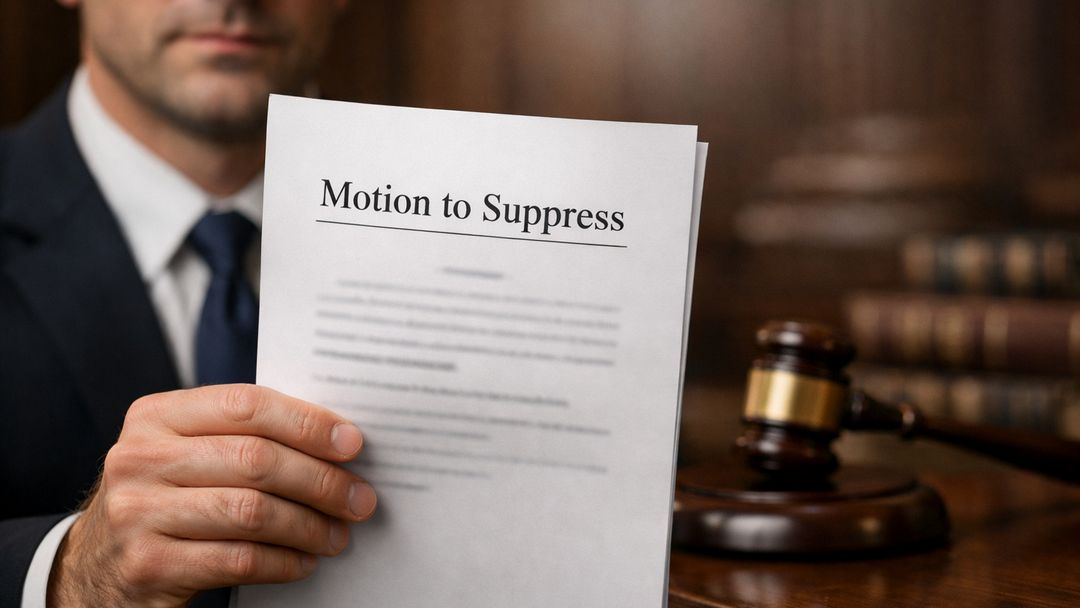
Defininition and Explaination – Motion in Limine
Overview
Although both a motion in limine and a motion to suppress deal with evidence, they serve very different purposes in Michigan criminal cases. Understanding the distinction is critical because each motion affects the trial in its own way and relies on different legal standards. Komorn Law regularly litigates both types of motions to protect clients’ constitutional rights and prevent improper evidence from reaching the jury.
What Is a Motion to Suppress?
A motion to suppress asks the court to exclude evidence because it was obtained in violation of a defendant’s constitutional rights. These motions typically involve:
- Fourth Amendment illegal searches or seizures
- Fifth Amendment violations (e.g., Miranda issues)
- Sixth Amendment right‑to‑counsel violations
- Unlawful traffic stops
- Invalid warrants
- Coerced statements If the court grants a motion to suppress, the evidence is completely barred from trial because it was unlawfully obtained. See Mapp v. Ohio, 367 U.S. 643 (1961) (exclusionary rule).
What Is a Motion in Limine?
A motion in limine is a pretrial request asking the judge to decide whether certain evidence should be excluded or allowed before the jury hears it. Unlike a motion to suppress, it does not depend on constitutional violations. Instead, it focuses on the Michigan Rules of Evidence, such as:
-
MRE 401–403 (relevance and prejudice)
-
MRE 404(b) (other‑acts evidence)
-
MRE 702 (expert testimony) A motion in limine is about trial fairness, not police misconduct.
Key Differences Between the Two Motions
Although both motions can keep evidence out of trial, they differ in purpose, timing, and legal basis:
| Issue | Motion to Suppress | Motion in Limine |
|---|---|---|
| Legal Basis | Constitutional violations | Michigan Rules of Evidence |
| Focus | Police conduct | Jury fairness & evidentiary rules |
| Timing | Usually early in the case | Typically right before trial |
| Effect | Evidence excluded entirely | Evidence excluded or limited at trial |
| Examples | Illegal search, Miranda violation | Prior bad acts, hearsay, prejudicial statements |
A motion to suppress challenges how evidence was obtained. A motion in limine challenges whether the jury should hear it.
Why Both Motions Matter in Criminal Defense
Strategic use of both motions can dramatically change the outcome of a case. A successful motion to suppress may eliminate key evidence, forcing the prosecution to reduce or dismiss charges. A motion in limine can prevent the jury from hearing damaging, irrelevant, or inflammatory information. Together, they help ensure a fair trial and protect constitutional rights.
Since 1993, Komorn Law, PLLC has aggressively defended clients in Michigan courts, litigating motions to suppress, motions in limine, and complex constitutional issues. If you are facing criminal charges or need strategic pretrial advocacy, contact us at 248‑357‑2550 or visit > KomornLaw.com
FAQs
Q: Can a motion in limine exclude evidence that was illegally obtained?
A: No. That requires a motion to suppress based on constitutional grounds.
Q: Can both motions be filed in the same case?
A: Yes. Many cases involve both constitutional issues and evidentiary concerns.
Q: When is a motion to suppress usually filed?
A: Early in the case, often before the preliminary exam or shortly after discovery.
Q: Does a motion in limine apply only to the prosecution’s evidence?
A: No. Either side may file one to control what the jury hears.
Q: What happens if the prosecutor violates a granted motion in limine?
A: The judge may issue sanctions, strike testimony, or declare a mistrial.
More

Coalition Forms to Support Voter Approved MRTMA
New Coalition Forms To Support Voter Approved Cannabis ActMichigan’s adult‑use cannabis framework was not created by accident. It was built through a deliberate, voter‑driven process culminating in the Michigan Regulation and Taxation of Marihuana Act (MRTMA). The Act...

Michigan Court of Appeals Orders City of Taylor to Release Police Misconduct Records
Case Summary The Michigan Court of Appeals has ruled that the City of Taylor must comply with a Freedom of Information Act (FOIA) request submitted by the ACLU of Michigan seeking police misconduct records dating back to 2021. The request covers documents involving...

Michigan Supreme Court and Court of Appeals Cases – Home Invasion
Case Summary In People v Berry, the defendant co‑owned a home with his former partner. After moving out and negotiating a buyout, he re‑entered the home with another individual before the agreement was finalized. Both were charged with first‑degree home invasion. The...

Cannabis Regulators Association-Briefing on Marijuana Schedule Change
Overview of the President’s December 18th Executive Order and the Implications When Marijuana is Rescheduled to Schedule III under the U.S. Controlled Substances ActTOP-LINE SUMMARY The President signed an Executive Order on December 18, 2025, ordering his...

Trump’s Marijuana Reclassification 2025
Donald Trump’s Actions On December 18, 2025, President Donald Trump signed an executive order reclassifying marijuana from a Schedule I to a Schedule III controlled substance under the federal Controlled Substances Act (CSA). This marks the most significant federal...

Michigan Supreme Court and Court of Appeals Cases – Felon in Possession
Case Summary In People v Hughes, the defendant challenged Michigan’s felon‑in‑possession statute on Second Amendment grounds. He argued the law was unconstitutional both on its face and as applied to nonviolent offenders. The Court of Appeals rejected both...

Michigan Supreme Court and Court of Appeals Cases – Controlled Substances
Case Summary In People v Soto (COA) the defendant faced a felony charge after an 85‑pound shipment of marijuana was delivered to her home. She argued that the Michigan Regulation and Taxation of Marihuana Act (MRTMA) shielded her from felony prosecution because the...

Michigan Supreme Court and Court of Appeals Cases – Confessions
Case Summary Michigan courts issued several important decisions clarifying when confessions are admissible, how Miranda applies in nontraditional settings, and what constitutes a valid invocation of counsel. In Lafey, a spontaneous statement made during a pat‑down was...

Fourth Amendment Search & Seizure — A Quick Summary
Fourth Amendment Search & Seizure — Quick Summary The Fourth Amendment protects individuals from unreasonable searches and seizures, limiting when and how the government may intrude on privacy. These protections apply only when police conduct qualifies as a search...

Marijuana Under Fire in Michigan
Marijuana in Michigan is facing renewed challenges as lawmakers push for higher taxes and regulatory changes that critics argue undermine the voter-approved legalization of 2018. Court battles, legislative maneuvers, and industry pushback highlight the tension between...