
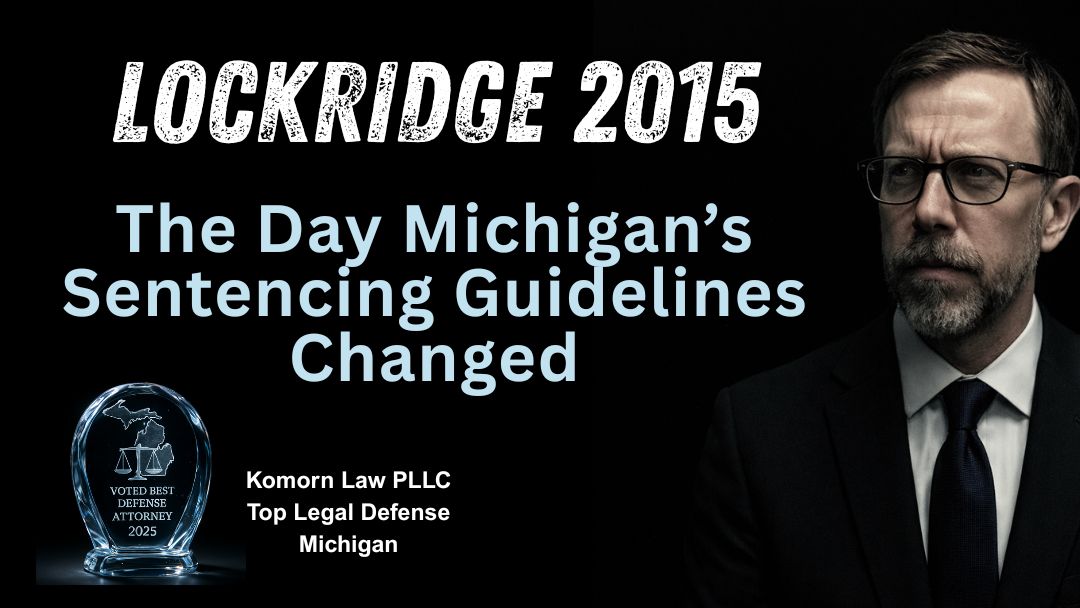
People v Lockridge, 498 Mich 358 (2015)
A Guide to One of the Most Important Early Stages in a Felony Case
Summary: The Day Michigan’s Sentencing Guidelines Changed
In 2015, the Michigan Supreme Court handed down a landmark decision in People v. Lockridge, 498 Mich 358 (2015), fundamentally altering the state’s criminal sentencing landscape.
Background
The Conflict Between Judges and Juries. The core of the Lockridge dispute lies in the Sixth Amendment right to a jury trial. Historically, the U.S. Supreme Court established in cases like Apprendi v. New Jersey and Alleyne v. United States that any fact that increases the penalty for a crime—beyond the prescribed statutory maximum or mandatory minimum—must be submitted to a jury and proved beyond a reasonable doubt.
In Michigan, the legislative sentencing guidelines required judges to “score” various variables (Offense Variables or OVs).
Historical Factual Case Details
The case originated with Kimani Lockridge, who was convicted by a jury of third-degree home invasion. During sentencing, the trial judge scored several Offense Variables, including OV 4 (psychological injury to a victim) and OV 9 (number of victims).
The jury had not made specific findings regarding these psychological injuries or the specific number of victims; the judge determined these facts independently. These scores pushed Lockridge’s sentencing guidelines into a higher bracket, essentially mandating a longer minimum prison term than would have been required based solely on the jury’s verdict. Lockridge challenged this, arguing that his constitutional rights were violated because a judge, not a jury, found the facts that increased his mandatory minimum sentence.
What’s at Stake
Judicial Discretion vs. Legislative Control
Prior to Lockridge, Michigan’s sentencing system was designed to ensure uniformity—the legislature wanted to make sure that two people committing the same crime in different counties received similar sentences.
However, the “mandatory” nature of this uniformity came at a cost. It stripped judges of the ability to look at the unique nuances of a case if those nuances fell outside the rigid grid. The stakes in Lockridge involved the balance of power:
-
For Defendants: It was about the right to have a jury of peers decide every fact that could lead to more prison time.
-
For the State: It was about maintaining a predictable, structured sentencing system that prevented “rogue” sentencing.
The Court’s Opinion
In a majority opinion authored by Justice Robert P. Young Jr., the Michigan Supreme Court held that the state’s sentencing guidelines were unconstitutional to the extent that they required a judge to increase a mandatory minimum sentence based on facts not found by a jury or admitted by the defendant.
To remedy this, the Court did not throw out the guidelines entirely. Instead, they performed “judicial surgery.” They severed the provision of the law that made the guidelines mandatory. The Court ruled that:
-
Guidelines are now advisory.
-
Sentencing courts must still “consult” the guidelines and take them into account.
-
A sentence that departs from the guidelines is now reviewed by appellate courts for “reasonableness.”
In Closing: The New Normal
People v. Lockridge represents one of the most significant shifts in Michigan criminal law in the last 20 years. While the guidelines still provide a “starting point” for every sentence, the “mandatory” shackles have been removed. This gives defense attorneys more room to argue for leniency and gives judges the freedom to impose sentences they believe truly fit the crime and the individual—provided they can justify the result as “reasonable.”
FAQ: Understanding the Impact of Lockridge
1. Does Lockridge mean judges can ignore the sentencing guidelines? No. Judges are still legally required to calculate and “consult” the guidelines. However, they are no longer strictly bound to stay within the calculated range if they believe a different sentence is more appropriate.
2. Can a judge still use facts not found by a jury? Yes. Under Lockridge, judges can still consider “judge-found facts” to score the guidelines, but because the guidelines are now advisory rather than mandatory, this no longer violates the Sixth Amendment.
3. What happens if a judge goes above the suggested guideline range? If a judge “departs” from the guidelines (either upward or downward), the appellate courts will review the sentence to determine if it is “reasonable.” The judge must provide substantial reasons on the record for the departure.
4. Did Lockridge apply to people already in prison? The ruling applied to cases that were still “pending on direct review” at the time the decision was released. It generally does not allow for the reopening of old cases where the appeals had already been exhausted.
5. How has this changed the work of defense attorneys? It has increased the importance of “sentencing advocacy.” Lawyers now focus more on “reasonableness” arguments, highlighting personal history, rehabilitation, and specific mitigating factors that the rigid guideline grid might have ignored.
Komorn Law, founded in 1993, brings decades of seasoned experience to Michigan’s most complex criminal and regulatory matters, including the evolving cannabis framework from the MMMA to today’s MRTMA landscape. The firm represents clients facing controlled‑substance offenses, DUI and drug‑related driving charges, firearm violations, property crimes, resisting or obstructing, and the most serious allegations such as manslaughter and homicide. With a proven record in courts across Michigan and the federal system, Komorn Law delivers strategic, relentless advocacy when the stakes are highest. To work with a firm that truly refuses to back down, call 248-357-2550.
More Articles
A Motion in Limine – What does it Mean?
Defininition and Explaination - Motion in LimineA motion in limine is a pretrial request asking the judge to exclude...

Michigan Supreme Court and Court of Appeals Cases – Threat of Terrorism
Case Summary In People v Kvasnicka, the defendant sent a message to a young girl stating she “would not be laughing”...
What is a Franks Hearing?
What is a Frank's Hearing?A Franks hearing is a critical legal tool used when a defendant claims that police lied,...
What Are Your First Amendment Rights For Now
The Constitution of the United States is the supreme law of the United States of America for now. It superseded the...
More

Trump’s Marijuana Reclassification 2025
Donald Trump’s Actions On December 18, 2025, President Donald Trump signed an executive order reclassifying marijuana from a Schedule I to a Schedule III controlled substance under the federal Controlled Substances Act (CSA). This marks the most significant federal...

Michigan Supreme Court and Court of Appeals Cases – Felon in Possession
Case Summary In People v Hughes, the defendant challenged Michigan’s felon‑in‑possession statute on Second Amendment grounds. He argued the law was unconstitutional both on its face and as applied to nonviolent offenders. The Court of Appeals rejected both...

Michigan Supreme Court and Court of Appeals Cases – Controlled Substances
Case Summary In People v Soto (COA) the defendant faced a felony charge after an 85‑pound shipment of marijuana was delivered to her home. She argued that the Michigan Regulation and Taxation of Marihuana Act (MRTMA) shielded her from felony prosecution because the...

Michigan Supreme Court and Court of Appeals Cases – Confessions
Case Summary Michigan courts issued several important decisions clarifying when confessions are admissible, how Miranda applies in nontraditional settings, and what constitutes a valid invocation of counsel. In Lafey, a spontaneous statement made during a pat‑down was...

Fourth Amendment Search & Seizure — A Quick Summary
Fourth Amendment Search & Seizure — Quick Summary The Fourth Amendment protects individuals from unreasonable searches and seizures, limiting when and how the government may intrude on privacy. These protections apply only when police conduct qualifies as a search...

Marijuana Under Fire in Michigan
Marijuana in Michigan is facing renewed challenges as lawmakers push for higher taxes and regulatory changes that critics argue undermine the voter-approved legalization of 2018. Court battles, legislative maneuvers, and industry pushback highlight the tension between...