

The case People of Michigan v. Freddie Wilkins III (No. 367209) revolves around a legal challenge regarding the search of a vehicle without a warrant.
Police conducted a warrantless search under the “automobile exception.”
The case People of Michigan v. Freddie Wilkins III (No. 367209) revolves around a legal challenge regarding the search of a vehicle without a warrant.
Wilkins appealed a conviction stemming from the discovery of unregistered firearms in his car after police conducted a warrantless search under the “automobile exception.”
This legal principle allows law enforcement to search a vehicle without a warrant if they have probable cause to believe it contains evidence of a crime.
In the Wilkins’ case, the search was triggered by the odor of marijuana, which raised questions under Michigan’s marijuana laws.
While the odor of marijuana previously constituted probable cause, recent changes under Michigan’s recreational marijuana law, the Michigan Regulation and Taxation of Marihuana Act (MRTMA), complicate this.
The court debated whether the smell of marijuana alone still justifies a search, especially since possession of small amounts is now legal for adults.
The appellate court highlighted that for the search to be lawful, additional suspicious factors would need to accompany the marijuana smell to support probable cause for finding contraband.
Use You Right To Remain Silent
If you have been accused or charged with a crime.
Say nothing to anyone. Talk to us first.
Our firm is experienced in both State and Federal courts defending clients.
CALL NOW
The case draws comparisons to similar rulings like People v. Armstrong, where Michigan courts have reconsidered the application of the automobile exception in light of the state’s evolving marijuana laws.
The central question in both instances revolves around whether the smell of cannabis, in conjunction with additional elements such as the driver’s deceptive behavior, provides sufficient grounds for conducting a search without a warrant.

The appeal in People of Michigan v. Freddie Wilkins III (No. 367209) was denied because the Michigan Court of Appeals found that there was no immediate need for further appellate review.
Wilkins had argued that the search of his vehicle was unconstitutional under the “automobile exception” because the smell of marijuana alone, without additional suspicious circumstances, did not provide probable cause to search the car.
However, the court determined that existing case law supported the legality of the search, particularly when other factors (such as the behavior of the suspect) combined with the odor of marijuana.
The appeal in People of Michigan v. Freddie Wilkins III (No. 367209) was denied because the Michigan Court of Appeals found that there was no immediate need for further appellate review.
Wilkins had argued that the search of his vehicle was unconstitutional under the “automobile exception” because the smell of marijuana alone, without additional suspicious circumstances, did not provide probable cause to search the car.
However, the court determined that existing case law supported the legality of the search, particularly when other factors (such as the behavior of the suspect) combined with the odor of marijuana.
Similar Cases
A number of legal cases have scrutinized the legitimacy of performing warrantless vehicle searches based on the scent of marijuana, especially in light of the evolving status of marijuana laws:
People v. Armstrong (2023): In this instance, the courts in Michigan reassessed the applicability of the automobile exception, taking into consideration the provisions outlined in the Michigan Regulation and Taxation of Marihuana Act (MRTMA).
The court ruled that while the smell of marijuana could still contribute to probable cause, it must be accompanied by other suspicious factors to justify a search. This case closely mirrors Wilkins, where the search was based on marijuana odor but also raised questions about unregistered firearms found during the search.
People v. Kazmierczak (2000): Previously, Michigan courts held that the smell of marijuana alone was sufficient to establish probable cause for a vehicle search.
However, this decision was later overruled in part due to changes in marijuana laws.
This case laid the groundwork for discussions like those in Wilkins, where courts must determine if the presence of marijuana (legal in small amounts) is enough to justify a search.
People v. Moorman (2020): During a traffic stop, a police officer detected the scent of marijuana, and when the defendant denied possessing any, this denial, along with the odor, provided the officer with probable cause to conduct a search of the vehicle.
The court found that the defendant’s behavior, along with the odor, justified the search, similar to the arguments presented in Wilkins. The ruling was based on the idea that such behavior suggests illegal possession beyond the legal limits
Note: This article provides a general overview and does not substitute for legal advice. Anyone charged with a CSC offense should consult an attorney for specific legal guidance.
More Articles

When Being Questioned by the Police: Can They Lie to You?
When Being Questioned by the Police: Can They Lie to You? Introduction In the United States, police officers are generally allowed to lie to suspects during interrogations. This is a controversial practice, but it has been upheld by the Supreme Court. There are some...

Michigan Executive Directives Update December 1 2023
What is an Executive Directive? Similar to executive orders, executive directives are issued by the Governor to establish basic internal policy or procedure for the executive branch of state government, assure the faithful execution of law, and to supervise state...

Michigan Executive Orders Update December 1 2023
What is an Executive Order? The Michigan Constitution of 1963 vests the executive power of the state in the Governor. That power can be exercised formally by executive order. Executive orders may reorganize agencies within the executive branch of state government,...
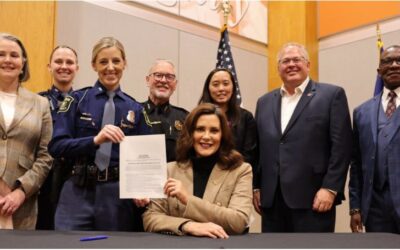
Whitmer signs bill stripping gun rights for non-violent offenders
Gov. Gretchen Whitmer proudly showcases a crucial bipartisan gun violence bill package that she recently signed into law, underscoring her unwavering dedication to safeguarding the lives of those vulnerable to domestic violence. This essential measure reflects the...

Ohio Bill Introduced to Allow Each City to Ban Marijuana
With just over a week until Ohio’s voter-approved marijuana legalization law takes effect, a lawmaker has introduced a bill that would allow individual municipalities to locally ban the use and home cultivation of cannabis in their jurisdictions. The legislation aims...

Legislation Brings Needed Changes to Educator Evaluation Laws
October 10, 2023 LANSING – Senate Bills 395-396 bring needed changes to Michigan’s time-intensive educator evaluation system and will allow teachers and school administrators to spend more time focused on students, according to the Michigan Department of Education....

It’s not hard to be accused of being a Menace in Michigan
“You are a menace, you’re talking louder than me, you don’t agree with me and now you're pointing at me with gun fingers. I feel threatened! I’m calling the police”. All over a minor disagreement - probably about paper or plastic. Police arrive and can only do what...

Disturbing the Peace – Laws and Penalties in Michigan
What are the laws and penalties of disturbing the peace in Michigan? Have you ever been in a situation where someone's behavior was so disruptive that it made you feel uncomfortable or unsafe? Maybe it was someone yelling loudly in public, creating a disturbance at a...

Delta-8 in Michigan
Delta-8 is a cannabis compound that has become popular because of its similarity to delta-9. Both delta-8 and delta-9 are cannabinoids and are similar in both their names and their chemical structures. THC is the part of the marijuana plant that produces the "high"...

Police found my friend’s drugs in my car-What do I do?
When you're pulled over by the police and your friend throws their stash under your seat. Are they still your friend? That's up to you. But at the moment you probably are going to take the fall, pay the price and have your life turned inside out and upside down. The...