
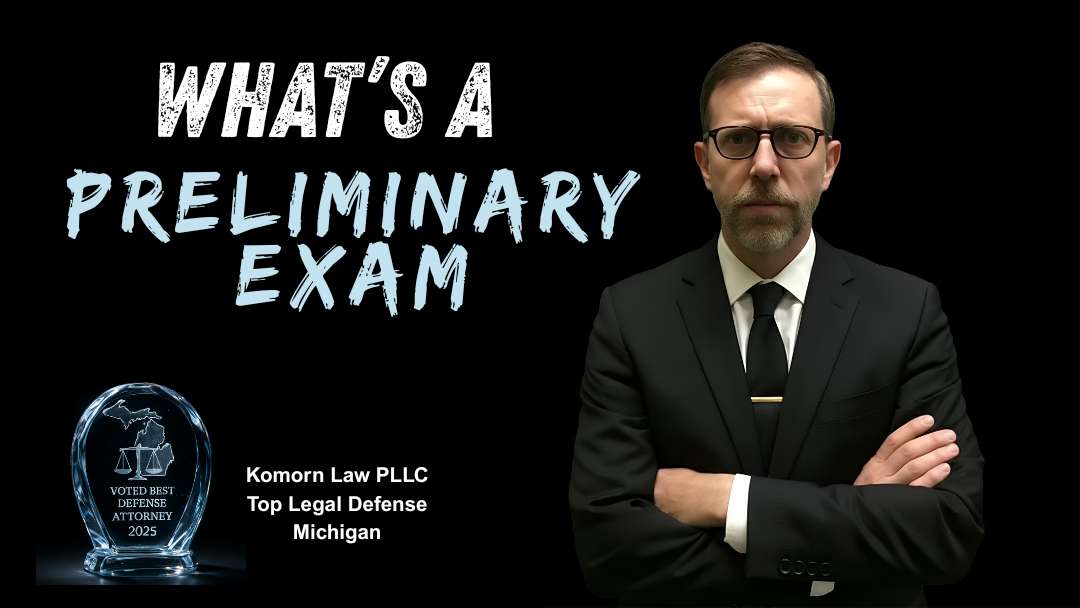
Michigan Preliminary Examinations
The Strategic Gatekeeper
in Felony Defense
The Preliminary Examination as the First Line of Defense
In Michigan felony cases, the preliminary examination (PE) is the first—and often most decisive—opportunity to challenge the government’s case. Before a felony can advance to Circuit Court, the prosecution must show that a crime occurred and that probable cause exists to believe the defendant committed it. This hearing is the jurisdictional checkpoint that prevents unsupported or overcharged cases from moving forward.
Because the PE is designed as a screening mechanism, it becomes a critical moment for defense counsel to expose weaknesses, test the prosecution’s theory, and force the state to justify its charges under oath.
The Low Probable Cause Standard and Its Tactical Impact
The probable cause standard is intentionally minimal. It requires only a reasonable belief—not certainty, not even likelihood—that the defendant may have committed the offense. While a trial demands proof beyond a reasonable doubt, the PE requires only a fraction of that showing.
Magistrates are instructed to bind a case over unless the evidence is so unreliable or contradictory that no reasonable person could believe guilt is possible. This means close calls favor the prosecution. For the defense, this reality makes preparation and strategy essential. The low standard does not diminish the importance of the hearing—it heightens it.
Why Defense Should Almost Always Hold the PE
The document outlines several strategic advantages to holding the examination:
Locking in Testimony
Witnesses are often unprepared, making the PE the best opportunity to secure sworn statements for later impeachment.
Real Discovery
Police reports are “curated fiction.” The PE forces the prosecution to reveal actual evidence and witness performance.
Preserving Favorable Testimony
If a witness is recanting or wavering, the PE transcript preserves their statements even if they later disappear or change their story.
Assessing Witness Demeanor
The PE provides the first real look at how witnesses handle pressure.
The document also warns of risks—such as locking in damaging testimony or enabling prosecutors to add charges under People v Hunt—but concludes that for a specialist, the benefits overwhelmingly favor holding the exam.
Using the PE Transcript as a Strategic Weapon
Once the case reaches Circuit Court, the PE transcript becomes the backbone of post‑bindover litigation.
Motion to Quash
A magistrate’s factual findings are reviewed for abuse of discretion (People v Talley), while legal conclusions are reviewed de novo (People v Stone). This gives defense counsel a second chance to challenge weak evidence.
Motion to Suppress
Cross‑examination at the PE can establish the factual foundation for Fourth or Fifth Amendment challenges. The document notes that counsel should use the officer’s own testimony to show the defendant was not free to leave or was questioned without Miranda warnings.
The transcript reveals:
-
Inconsistencies between witness accounts
-
Missing elements of the offense
-
Hearsay issues
-
Weaknesses in the prosecution’s theory
-
Opportunities for impeachment
This early record often shapes the entire defense strategy.
Procedural Rules That Can Make or Break the Case
The PE is governed by strict jurisdictional timelines. The Probable Cause Conference must occur within 7–14 days of arraignment, and the PE must follow within 5–7 days unless “good cause” is shown. “Simple docket congestion” is not good cause and can justify dismissal.
The document also highlights MCL 766.11b, which allows lab and autopsy reports without live testimony—a rule upheld in People v Parker. Defense must object to preserve later challenges.
Outcomes and Final Recommendations
A PE typically ends in one of three results:
-
Bindover to Circuit Court
-
Reduction to a misdemeanor
-
Discharge for lack of probable cause
The document stresses that counsel must file a Motion to Quash immediately after receiving the transcript, citing People v Fleming, which holds that failing to challenge sufficiency in the trial court waives appellate review.
Case to Review
FAQs
What is the purpose of a preliminary examination?
It screens felony charges to ensure the prosecution has evidence of a crime and probable cause linking the defendant.
Is the probable cause standard high?
No. As the document notes, it is roughly a “3%” certainty threshold—far below the trial standard.
Should the defense waive the PE?
Generally no. The PE provides critical discovery, impeachment material, and strategic leverage.
Can the PE lead to additional charges?
Yes. Under People v Hunt, prosecutors may add charges if testimony supports them.
What happens if the magistrate makes a legal error?
Defense may file a Motion to Quash, which receives de novo review on legal issues.
Komorn Law, founded in 1993, brings decades of seasoned experience to Michigan’s most complex criminal and regulatory matters, including the evolving cannabis framework from the MMMA to today’s MRTMA landscape. The firm represents clients facing controlled‑substance offenses, DUI and drug‑related driving charges, firearm violations, property crimes, resisting or obstructing, and the most serious allegations such as manslaughter and homicide. With a proven record in courts across Michigan and the federal system, Komorn Law delivers strategic, relentless advocacy when the stakes are highest. To work with a firm that truly refuses to back down, call 248-357-2550.
More Articles
Trump’s Marijuana Reclassification 2025
Donald Trump’s Actions On December 18, 2025, President Donald Trump signed an executive order reclassifying marijuana...

Michigan Supreme Court and Court of Appeals Cases – Felon in Possession
Case Summary In People v Hughes, the defendant challenged Michigan’s felon‑in‑possession statute on Second Amendment...

Michigan Supreme Court and Court of Appeals Cases – Controlled Substances
Case Summary In People v Soto (COA) the defendant faced a felony charge after an 85‑pound shipment of marijuana was...
No Results Found
The page you requested could not be found. Try refining your search, or use the navigation above to locate the post.
More

Obstruction Laws in Michigan
Move along or you'll be arrested for Obstruction of "Justice".In Michigan, obstruction is a crime that involves interfering with law enforcement or other officials when they are trying to carry out their duties. Obstruction can cover a wide range of actions, including...

Defending against false accusations of Criminal Sexual Conduct
Defending against false accusations of Criminal Sexual Conduct (CSC) in MichiganDefending against a false accusation of Criminal Sexual Conduct (CSC) in Michigan is a serious matter and requires a well-prepared legal strategy. Here are several steps you should take to...

Can I sue for being falsely accused of Criminal Sexual Conduct
If you are innocent and falsely accused of Criminal Sexual Conduct (CSC) in Michigan can you sue?Yes, if you have been falsely accused of Criminal Sexual Conduct (CSC) in Michigan and can prove that the accusations were malicious or knowingly false, you may be able to...

Resisting Arrest in Michigan
Stop resisting! Stop resisting!In Michigan, resisting arrest is a serious crime. Under Michigan Compiled Law (MCL) 750.81d, it is illegal to resist or obstruct a police officer or any other law enforcement official when they are performing their duties. This law...

Probable Cause v Reasonable Suspicion
What's the difference between probable cause and reasonable suspicion?Definition of Probable Cause Probable cause refers to the belief held by a reasonable person that a crime is currently being committed, has already been committed, or is likely to be committed in...

False accusations of Criminal Sexual Conduct (CSC) in Michigan
False accusations of Criminal Sexual Conduct (CSC) are a serious.False accusations of Criminal Sexual Conduct (CSC) are a serious issue and can have devastating consequences for the accused. While it’s important to recognize that sexual assault is a significant...